6 Paddleboard Habits That Are Quietly Wearing Out Your Shoulders
Quick Answer: Most paddleboard shoulder problems come from paddling with the arms instead of the torso, a paddle set too long, and a stroke that continues past the hip. The shoulder ends up doing work the trunk should be doing, in a raised and internally rotated position, several thousand times per session. The three changes with the largest effect: shorten the paddle, end the stroke at your feet, and rotate the torso so the arms mostly hold their shape rather than pulling.
A two-hour paddle is somewhere between two and three thousand strokes.
Any position that is slightly wrong at stroke one is very wrong by stroke two thousand.

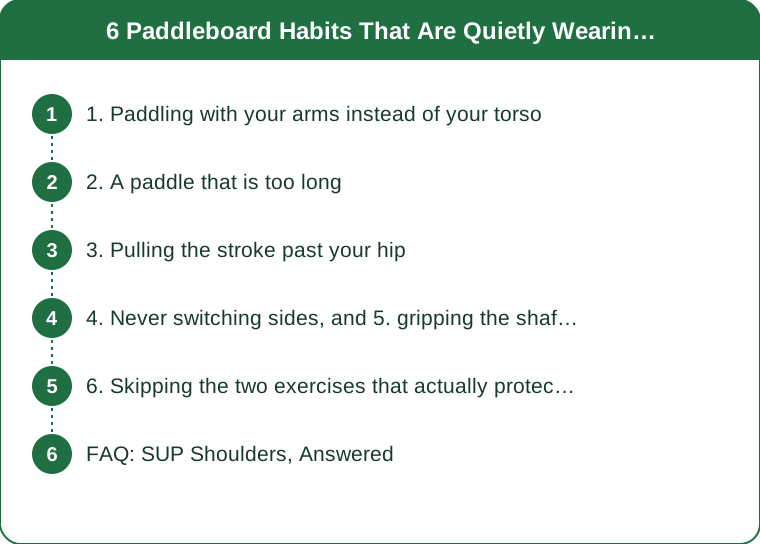
1. Paddling with your arms instead of your torso
The stroke is meant to be driven by trunk rotation. The arms hold a relatively fixed frame while the torso turns, and the large muscles of the back and core supply the power.
Arm paddling puts the entire load on the shoulder, repeated thousands of times per outing, which is exactly the profile that produces overuse rather than injury from a single event.
The tell is a bending lower arm. If your bottom elbow flexes noticeably during the pull, you are pulling with the arm. It should stay relatively straight while the body rotates.
Fatigue converts everyone into an arm paddler eventually, which is why the last twenty minutes of a long paddle produce most of the trouble.
The fix is to think about the top hand pushing rather than the bottom hand pulling, which shifts the emphasis toward the trunk almost automatically.
2. A paddle that is too long
Too long is by far the more common error, and it forces the top hand above shoulder height on every single stroke.
Overhead reach with load is the position the shoulder tolerates least well over high repetitions. Repeating it thousands of times per session is the mechanism behind most SUP shoulder complaints.
A long paddle also promotes a wide, sweeping stroke away from the board, which adds a rotational demand at the shoulder that a vertical stroke does not.
Six to eight inches above your height is a common starting range for all-round paddling, with touring and racing preferences varying from there.
When in doubt go shorter, particularly for long distances. A slightly short paddle costs a small amount of power and prevents a great deal of accumulated load.
3. Pulling the stroke past your hip
Propulsion effectively ends when the blade passes your feet. Everything after that lifts water rather than moving the board, which is work with no reward.
The end of the stroke is also where the shoulder is most extended and most vulnerable, so the least useful part of the stroke is also the most costly one.
It lifts the tail and pushes the nose down in the long trailing position, which is inefficient in addition to being hard on the joint.
Exiting at the feet feels wrong at first, because a long stroke feels powerful. Stroke rate rather than stroke length is where speed actually comes from.
Watch your own hands rather than the blade for the first few sessions - when the bottom hand reaches your hip, the stroke is over.

4. Never switching sides, and 5. gripping the shaft too hard
4. Paddling too long on one side
Asymmetric loading is how one shoulder becomes the problem shoulder. Switching every eight to twelve strokes distributes load and is also better for tracking straight.
People avoid switching because it briefly slows them, and then paddle twenty minutes on one side because the wind is pushing them - which is exactly the scenario that produces a season-ending shoulder.
Switch on a count rather than on feel, because feel will always favour the strong side.
5. Gripping the shaft too tightly
A tight grip transmits tension straight up the forearm into the shoulder and keeps the whole chain contracted for the entire session.
The bottom hand needs only enough grip to control the blade, and the top hand should be nearly open, pushing rather than holding.
Cold water and cold air make people grip harder without noticing, which is why late-season paddles produce more shoulder complaints than midsummer ones at the same distance.
6. Skipping the two exercises that actually protect the shoulder
External rotation work is the single most useful thing to add. Paddling loads internal rotators heavily and external rotators barely, and that imbalance is what most shoulder programmes exist to correct.
Scapular control work matters as much as rotator cuff work. Rows, band pull-aparts and serratus work give the shoulder blade a stable base to move on, and an unstable base is what turns paddling volume into pain.
Two sessions a week of ten minutes is enough to meaningfully change the balance across a season, which is a small investment against a common problem.
Do it in the off-season as well. Shoulder capacity built in winter is what carries a summer of high volume, and starting in July is starting late.
Warm up the shoulders before paddling, even briefly. Arm circles, band pull-aparts and a few minutes of easy paddling before pushing the pace.
And if pain is already present, particularly night pain, a painful arc, or weakness, get it assessed rather than adjusting technique around it. This is general information, not medical advice.
FAQ: SUP Shoulders, Answered
How do I know if my paddle is too long?
If your top hand goes above your head on a normal stroke, it is too long. Six to eight inches over your height is a reasonable all-round starting point.
How often should I switch sides?
Every eight to twelve strokes for most recreational paddling. Count it rather than judging by feel.
Should the stroke really end at my feet?
Yes for propulsion. Anything past the hip is lifting water and loading the shoulder in its least favourable position.
Is a lighter paddle worth the money?
Over thousands of strokes, yes - the weight difference is small per stroke and substantial per session, and it is one of the few equipment upgrades with a clear ergonomic case.
What about sore shoulders the next day?
General muscular soreness after an unusually long paddle is normal. Sharp pain during the stroke, pain at night, or weakness lifting the arm is not, and warrants assessment. This is general information, not medical advice.
Does board type affect the shoulder?
Indirectly - a wider, slower board requires more strokes for the same distance, and more strokes means more total load. Late season, when conditions are choppier, that difference gets larger.
TL;DR:
- Drive the stroke with torso rotation; a bending bottom elbow means you are paddling with the arm.
- Too long a paddle forces the top hand overhead on every stroke - six to eight inches above your height is a sensible starting range.
- End the stroke at your feet; everything past the hip lifts water and loads the shoulder at its most extended.
- Switch sides every eight to twelve strokes on a count, not on feel, and keep the top hand nearly open.
- Ten minutes twice a week of external rotation and scapular work protects a whole season.
Night pain, a painful arc, or weakness lifting the arm needs assessment rather than a technique tweak.
Keep Reading
This article is for general informational and styling purposes only. Fit, sizing, and product availability may vary.