7 Paddleboard Mistakes That Only Show Up When You Paddle Against a Current
Quick Answer: Against a current, any inefficiency in your stroke costs you ground rather than just speed, so problems you never noticed become obvious. The most common are a stroke that finishes too far back, standing too upright, a cadence that is too slow, and paddling with the board yawing side to side. Each one is fixable, and fixing them helps on flat water too — you just could not see them there.
You have paddled all summer and felt competent. Then you turn upstream and go nowhere, and it feels like the water is personally involved.
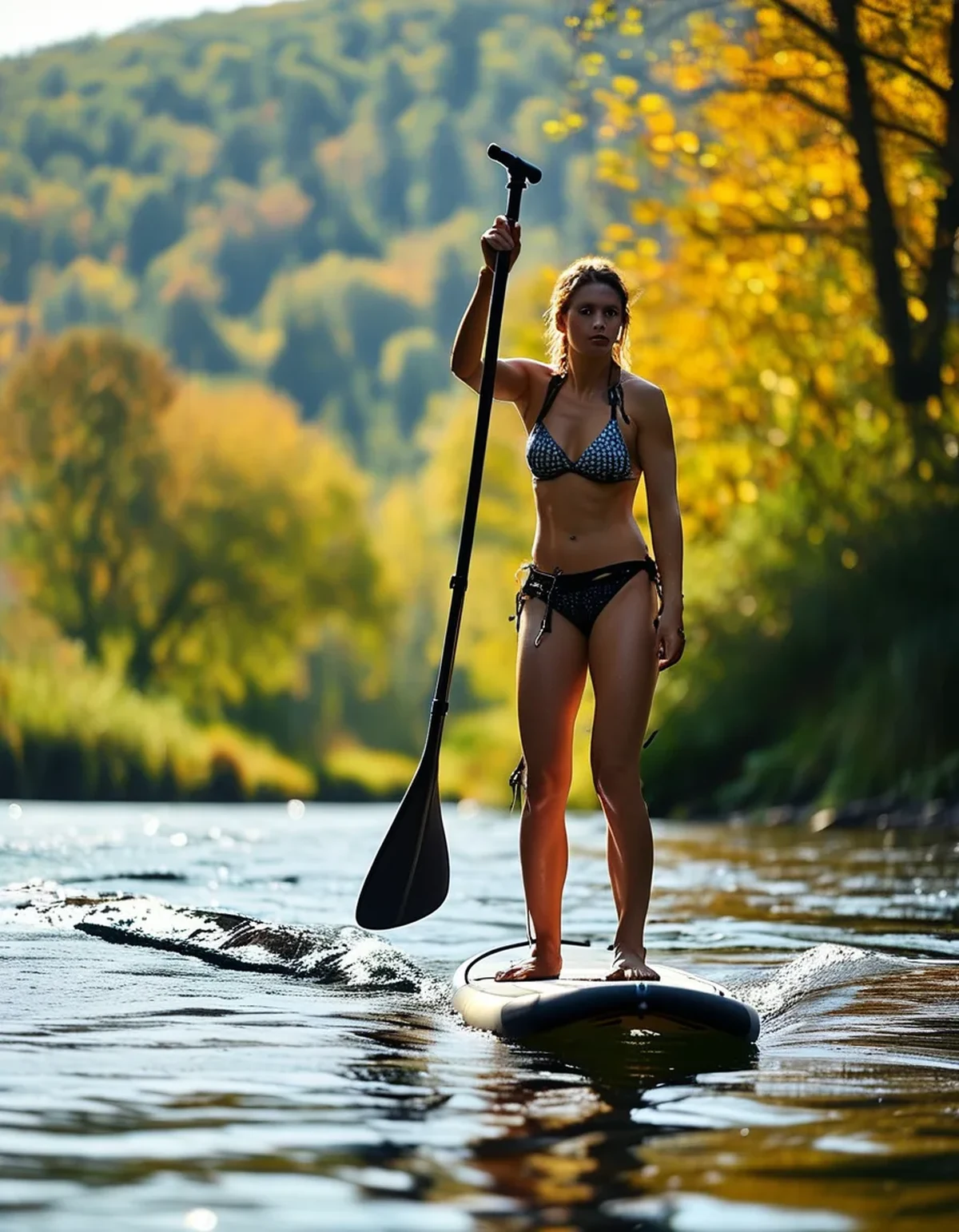
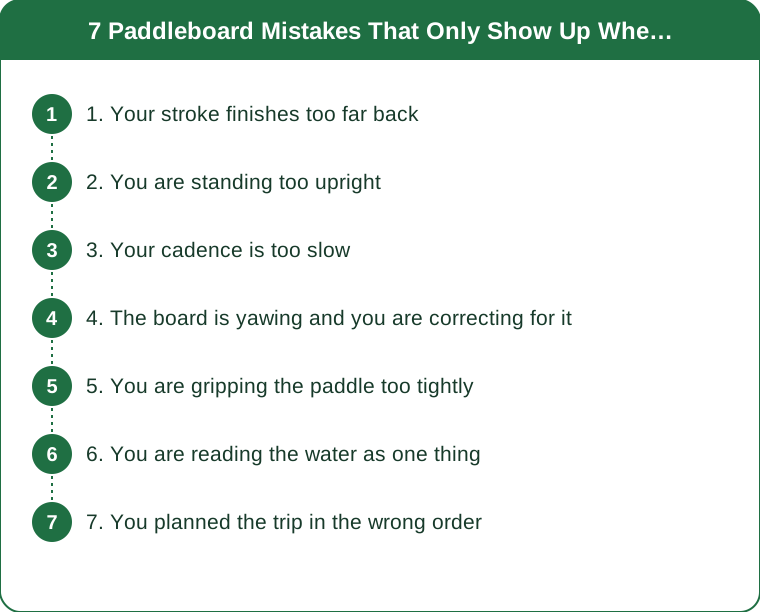
1. Your stroke finishes too far back
On flat water, a long stroke feels powerful and you get away with it. Against a current, it is the single biggest cost.
All the useful propulsion in a paddleboard stroke happens between the catch, when the blade enters ahead of your feet, and roughly your ankle. Past that point the blade is lifting water rather than pushing it backwards, which raises the tail, wastes energy, and adds a moment that turns the board.
Against a current, everything you waste is ground lost rather than speed lost, because the water is actively moving you backwards during the recovery.
The fix: exit the blade at your feet. It will feel like a short, unsatisfying stroke for the first ten minutes and then it will feel like the correct one. Count if it helps — catch, pull, out — and make the out happen earlier than instinct says.
Most people gain more from this single change than from any equipment decision.
2. You are standing too upright
Upright is comfortable and it puts your weight in the wrong place.
A standing paddler is a sail. Into a headwind — which frequently accompanies a current — an upright torso catches meaningful air. More importantly, standing tall means the stroke comes mostly from the arms, because there is no hinge available at the hips to drive it.
The fix: soften the knees, hinge slightly forward from the hips, and keep the chest low enough that you can reach further forward at the catch. This lowers your profile and, more usefully, brings the larger muscles of the back and trunk into the stroke.
There is a stability benefit too. A lower centre of mass with soft knees handles chop and boat wash far better than locked legs and a straight back, which is exactly what you meet when a current runs past an obstruction.
3. Your cadence is too slow
Slow, powerful strokes feel efficient. Against a current they are not.
Between strokes, the current is pushing you backwards. A long recovery phase means more time spent losing ground, so a slower cadence with a bigger pull often nets less progress than a quicker one with a smaller pull.
There is also a stability argument. A blade in the water is a point of support. A higher cadence means less time with no support, which matters when the water is textured.
The fix: count your strokes per minute on flat water, then deliberately raise it by ten or fifteen against a current while shortening the stroke to match. Most people find they can hold this comfortably and are simply not used to it.
This pairs directly with the first mistake — a stroke that exits at the feet is naturally quicker, and the two changes reinforce each other.
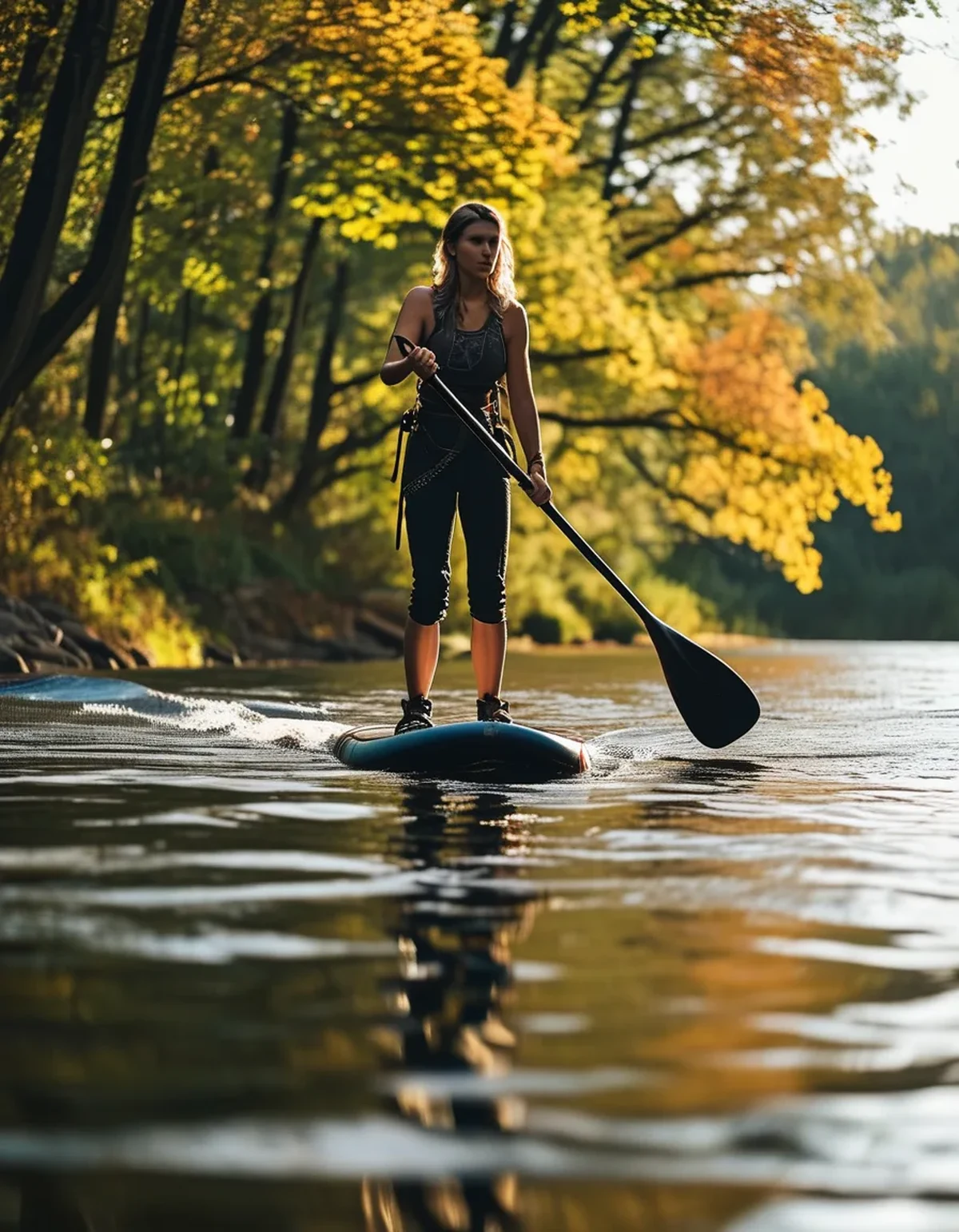
4. The board is yawing and you are correcting for it
Watch a struggling paddler from the bank and you will see the nose swinging left and right with every stroke.
Every degree of yaw is energy going sideways instead of forwards, and every correction stroke is a stroke that is not propelling you. On flat water this is merely inefficient. Against a current it is the difference between progress and none.
The usual causes are a stroke that runs past the feet, a blade angled away from the board, and paddling with the shaft not vertical enough.
The fix: get the shaft closer to vertical by reaching your top hand further across the board, and keep the blade path parallel to the centreline rather than sweeping outwards. A vertical shaft is the single most reliable cure for yaw.
Swapping sides more often helps too — every four or five strokes rather than every ten. It costs a fraction of a second and it prevents the accumulated drift you would otherwise correct for.
5. You are gripping the paddle too tightly
Tension is the default response to difficulty and it is expensive.
A hard grip fatigues the forearms quickly, and forearm fatigue is what ends most upstream efforts long before the legs or lungs are involved. It also transmits every bit of chop straight up your arms.
The fix: the lower hand holds firmly, the upper hand mostly guides. Think of pushing the top of the paddle forward with an open palm rather than gripping and pulling. Your grip should be loose enough that you could let go of the top hand entirely without dropping the paddle.
A related point worth checking: a paddle that is too long forces a wider grip and more shoulder work, and against a current that shows up quickly. If your upstream sessions consistently end with shoulder rather than trunk fatigue, the paddle length is worth measuring.
6. You are reading the water as one thing
A current is not uniform, and treating it as uniform makes every upstream trip harder than it needs to be.
Water moves fastest in the deepest channel and slowest near the banks, around the inside of bends, and behind obstructions. A paddler hugging the bank going upstream is doing considerably less work than one in the middle, and the difference is often large.
The fix: go upstream near the inside of bends and downstream in the channel. Use eddies behind rocks, moored boats and bridge supports as rest points — they are genuinely still water and they are free.
This is the skill that separates people who find moving water exhausting from people who find it interesting. It is entirely a reading skill, not a fitness one, and it is the fastest-improving thing on this list once you start looking.
Autumn matters here. Rainfall increases flow rates and the same familiar stretch can be moving noticeably faster than it was in August, with more debris in it.
7. You planned the trip in the wrong order
The last one is not technique at all and it ruins the most sessions.
Going downstream first feels wonderful and is a trap. You cover ground quickly, you go further than intended, you get tired, and then you have to come back against the current with whatever is left.
The fix: paddle upstream first, always, on any moving water. You do the hard work fresh, you get a clear read on how strong the current is before you commit, and the return leg is the easy one.
The turnaround rule: if the upstream leg took a certain amount of effort and time, budget that you will not have the same again. Turn back earlier than feels necessary.
And the wind version of the same rule: wind can reverse during the day, and a headwind out does not guarantee a tailwind back. In autumn, with shorter daylight and colder water, the cost of misjudging this is considerably higher than it was in July. Check the forecast for the whole session, not just the start.
TL;DR:
- Exit the blade at your feet — a long stroke past the hips is the biggest single cost against current.
- Hinge forward with soft knees, raise your cadence, and keep the shaft vertical to stop yaw.
- Loosen the grip, and read the water: inside of bends upstream, channel downstream, eddies as rest.
- Always paddle upstream first, and turn back earlier than feels necessary.
Pick the first one for your next session. Everything else on this list gets easier once the stroke stops running past your feet. This is general information, not medical advice.
Keep Reading
This article is for general informational and styling purposes only. Fit, sizing, and product availability may vary.