7 Signs Your Paddling Technique Is Costing You Your Lower Back
Quick Answer: Most SUP back pain comes from paddling with the spine rather than the hips — rounding forward to reach, then pulling with the lower back instead of rotating the trunk over stable hips. The signs show up as one-sided tightness, a stroke that shortens through a session, and a back that hurts more the day after an easy paddle than a hard one. Hinge at the hips, rotate the torso, and let the top hand drive the blade.
Your shoulders are fine. Your back is the thing that stops you getting on the water twice in a weekend.
And it never hurts while you are paddling, which is exactly why it takes people two seasons to work out what is causing it.
Here are the seven signals that show up first, in roughly the order most paddlers meet them.
1. Your stroke gets shorter as the session goes on
This is the earliest sign and the easiest one to dismiss.
A healthy stroke reaches forward from hip rotation. When your hips stop contributing — because they are tired, tight, or were never involved — the reach has to come from somewhere, and the somewhere is spinal flexion.
Watch your catch point relative to your feet. Early in a session it should be well ahead of your forward foot. If it has drifted back to level with your toes by minute 40, your hips have stopped working and your lumbar spine has taken over.
The fix is a cue, not more strength. Think about pushing your hips back slightly as you reach, so the movement is a hinge rather than a curl. Most people find their reach comes back immediately, which tells you the range was never missing.
Test it on land in 20 seconds: stand up, reach forward as though catching, and put your other hand on your lower back. If you feel the lumbar spine rounding under your hand, that is the shape you have been paddling in for however many hours.
2. One side of your lower back tightens and the other does not
Asymmetry is the clearest evidence that technique rather than load is the problem.
Paddling is inherently one-sided, and switching sides is what keeps it balanced. Most recreational paddlers switch far less often than they think — typically every 15 to 20 strokes when asked, and every 40-plus when actually counted.
The tight side is usually the one you paddle on more, and specifically the quadratus lumborum on that side, which works hard to stabilise the pelvis while the trunk rotates.
Count your switches for one session. Every 8 to 10 strokes is a reasonable target, and going to it from 40 usually resolves one-sided tightness within a couple of outings.
And check your stance while you are at it. A staggered stance — one foot slightly forward — is common, comfortable, and quietly makes the asymmetry worse if you never swap which foot leads. Alternate it deliberately, the same way you alternate paddling sides.
3. It hurts more after easy paddles than hard ones
This one confuses people and it is diagnostically useful.
Hard paddling tends to produce better technique, because reaching for power recruits the hips and trunk automatically. Easy paddling lets you slump, and 90 minutes of relaxed slumping loads passive structures — discs and ligaments — rather than muscle.
Muscular fatigue resolves in a day. Passive-structure loading tends to ache the next morning and feel worst getting out of bed, which is the pattern most people describe.
A slow paddle is not automatically a gentle one for your back. On a long easy session, deliberately reset your posture every 10 minutes — stand tall, roll the shoulders back, re-find the hinge. Setting a repeating timer is not overkill on a two-hour flat-water day.
The related tell: it hurts more on flat calm water than in chop. Chop forces constant postural adjustment, which keeps things moving. Glassy conditions let you hold one shape for an hour, and one shape held for an hour is what actually causes trouble.
4. You are pulling with your arms and 5. your top hand is doing nothing
These two travel together, so they are worth treating as a pair.
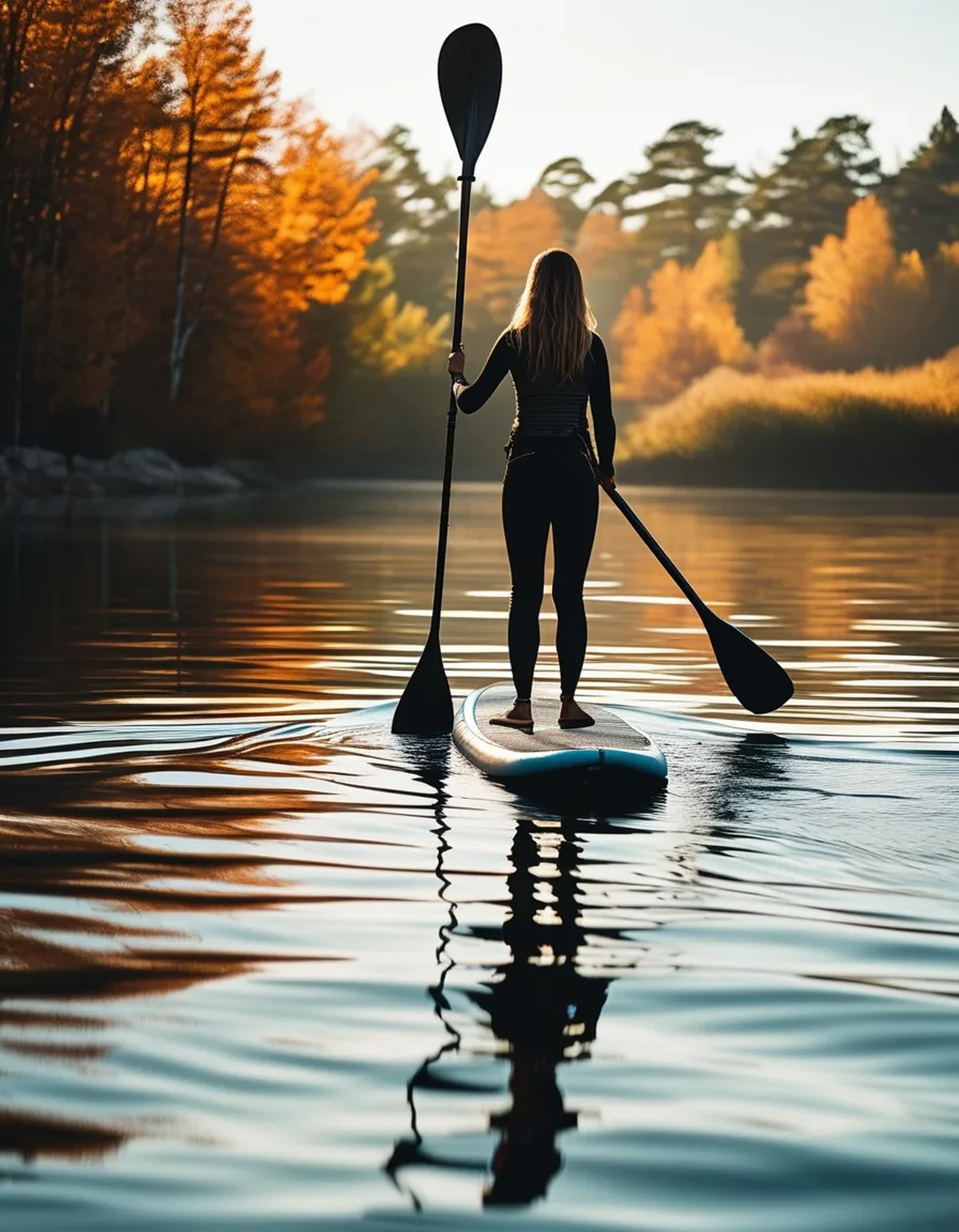
A paddle stroke is a push from the top hand as much as a pull from the bottom. The top hand should be driving down and forward, roughly at eye to forehead height at the catch. When it drops low, the blade cannot be planted vertically and the stroke becomes a pull across the body.
A cross-body pull rotates your trunk against a fixed pelvis — which loads the lower back with rotation and side-bend simultaneously, the least favourable combination there is.
Signs your top hand has quit:
- Forearm burn on the bottom hand within 20 minutes
- The board yawing side to side rather than tracking straight
- Shoulder soreness at the front, and lower back stiffness at the same time
- A stroke that feels splashy at the catch
Fix the height first. Consciously keeping the top hand high for 10 strokes usually corrects the plant, the pull path, and the trunk rotation all at once — it is the single highest-return cue in paddling and the one that lapses fastest when you stop thinking about it.
6. Your paddle is the wrong length, and 7. you never warm up your hips
The two setup problems that create technique problems.
A paddle that is too short forces you to bend forward to reach the water. The common recommendation for all-round SUP is roughly 6 to 8 inches above your height, and rentals are frequently set for the last person rather than for you. Check it every single time on a rental — it takes five seconds.
Too long is a different problem — it pushes the top hand higher than is comfortable and encourages a side-bend to compensate. Both errors end in the lumbar spine.
And the hips. Paddling demands hip hinge range and trunk rotation, and most people arrive at the water having sat down for the previous nine hours. Four minutes of preparation changes the first twenty minutes of the session, which is when technique is being set for the day:
- 10 hip hinges with hands on the paddle shaft, feeling the hamstrings load
- 10 standing trunk rotations per side, paddle across the shoulders
- 10 side bends, slow, through a comfortable range
- 20 seconds per side of a standing quad stretch, which quietly opens the front of the hip
What nobody tells you: the paddlers who never get back pain are rarely the strongest ones. They are the ones who set the paddle correctly, switch sides constantly, and reset their posture without being reminded. All three are free, and none of them are about fitness. This is general information, not medical advice — new, severe, or radiating back pain needs a professional.
FAQ: SUP Back Pain, Answered
Should I paddle sitting or kneeling if my back hurts?
Kneeling is a reasonable short-term modification and sitting usually is not. Kneeling keeps the hinge and rotation available while reducing the balance demand; sitting on a board tends to put you in exactly the rounded position causing the problem. If kneeling is comfortable and standing is not, that is useful information about your hinge rather than your board.
Does core strength fix this?
It helps and it is not the primary answer. A strong trunk that is being used in a rounded, rotated position is still being loaded badly. Technique first, then strength to support it. If you want the highest-value exercises: hip hinges, side planks, and Pallof presses — the last two train exactly the anti-rotation and anti-side-bend the stroke needs.
Is an inflatable board harder on my back than a hard board?
Slightly, through stability. An under-inflated board flexes underfoot and makes you work harder to stay balanced, which encourages a braced, stiff posture. Inflate to the manufacturer’s stated pressure — usually 12 to 15 psi — and check it on cool mornings, since pressure drops with temperature. A soft board in autumn water is a very common and completely avoidable cause of a bad session.
How long should I rest if my back is already sore?
If it is ordinary muscular soreness, 2 to 3 days and then a shorter session with deliberate attention to the hinge. If it is sharp, radiates into a leg, or is not improving within a week, stop guessing and see a physiotherapist. Paddling with a genuine lumbar injury is how a two-week problem becomes a two-month one.
TL;DR:
- SUP back pain almost always comes from reaching with the spine instead of hinging at the hips.
- Watch for a shortening stroke, one-sided tightness, and pain that is worse after easy sessions.
- Switch paddling sides every 8 to 10 strokes, and alternate which foot leads.
- Keep the top hand high — it fixes the blade plant, the pull path, and the rotation at once.
- Check paddle length every time on rentals: roughly 6 to 8 inches above your height for all-round paddling.
- Four minutes of hip hinges and trunk rotations before launching changes the whole first twenty minutes.
None of these seven cost anything or require you to be fitter, which is the good news buried in the list.
Keep Reading
This article is for general informational and styling purposes only. Fit, sizing, and product availability may vary.