7 Signs the Water Is Changing Faster Than You Are This Late in the Season
Quick Answer: Late season catches paddlers out because air temperature recovers faster than water temperature, wind patterns become gustier and less predictable, daylight shortens quickly, and everyone else is off the water. Dress for the water rather than the air, shorten your outings, and stop relying on the safety net of other paddlers being nearby.
Nothing feels dangerous about a 74-degree afternoon in September. That is the problem.
The water underneath you is on a completely different schedule from the air above it, and every other variable — wind, light, traffic, rescue availability — moved against you while the air stayed pleasant.
Here are seven changes that show up now, and what each one actually requires you to do differently.

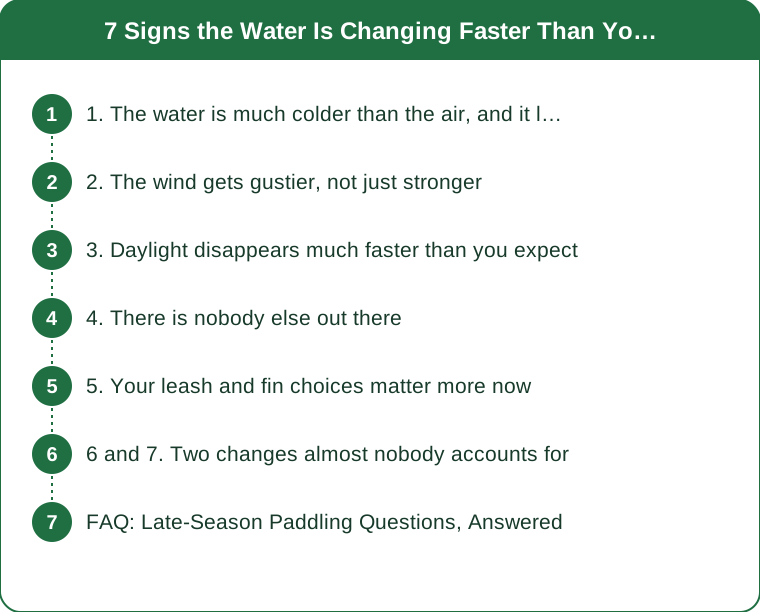
1. The water is much colder than the air, and it lags by weeks
Large bodies of water carry enormous thermal mass. Air warms and cools in hours; water takes weeks. By late season you routinely get a 20-degree gap between a pleasant afternoon and the water you would land in.
That gap is the single most under-appreciated hazard in autumn paddling. A fall into water in the 50s produces an involuntary gasp reflex, an immediate loss of breath control, and a rapid decline in hand function — all of it within the first minute, long before hypothermia is a factor.
What it demands:
- Dress for immersion, not for the forecast. If you would not swim in it comfortably, you need thermal protection: a wetsuit top, a drysuit, or at minimum neoprene layers.
- Check actual water temperature, not air. Local buoy data and lake monitoring stations publish it, and it will surprise you.
- Assume you will fall in. The version of you that plans as if a fall is likely makes very different, better decisions than the version who plans as if it is not.
2. The wind gets gustier, not just stronger
Summer wind on most water tends to be a predictable thermal pattern: calm morning, building afternoon breeze, evening drop. Autumn wind is frontal, which means it arrives in surges, shifts direction, and can go from flat to whitecaps in twenty minutes.
The practical failure mode: you paddle out with a light tailwind, and the return leg is into a wind that doubled while you were not paying attention.
What it demands:
- Always paddle out into the wind. Always. The tired leg should be the assisted one.
- Check the hourly forecast, not the daily. A daily average of 10 mph can conceal a 25 mph afternoon.
- Watch the water surface, not the trees. Darkening texture upwind is your earliest warning, and it gives you several minutes.
3. Daylight disappears much faster than you expect
In September you are losing daylight at a rate of a couple of minutes a day, and the loss compounds fast. The 6pm paddle that ended in comfortable light in August ends in dusk now.
Twilight on water is worse than twilight on land — the surface goes flat and featureless, depth perception fails, and finding a specific launch point along a dark shoreline is genuinely difficult.
What it demands:
- Set a hard turnaround time, not a hard distance. Sunset minus 60 minutes, no negotiation.
- Carry a light even on a short paddle. A headlamp and a white stern light, both waterproof.
- Know your launch from the water in the dark. Pick a landmark that is still visible when the shore is a silhouette.
4. There is nobody else out there
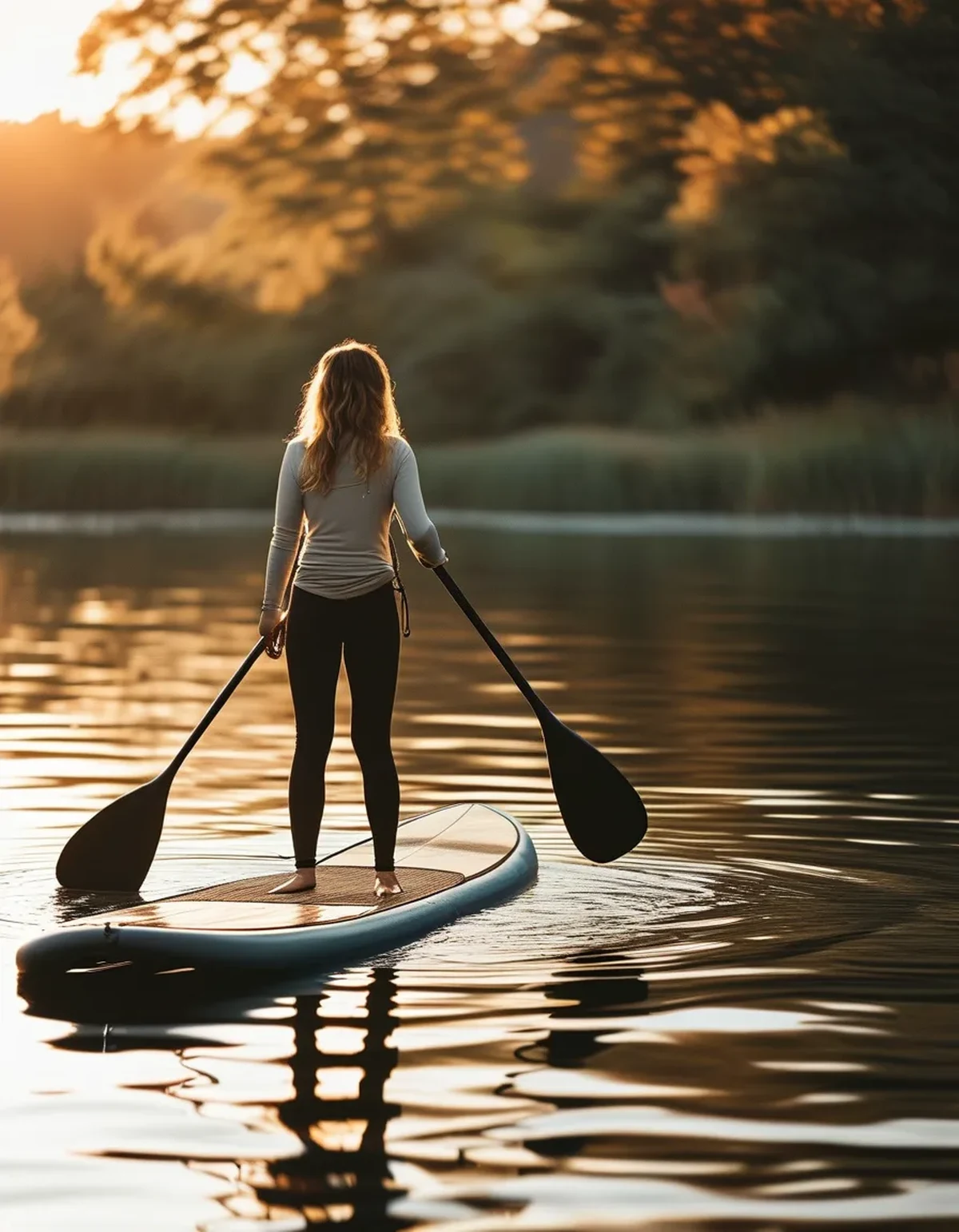
Through summer, the informal safety net is enormous — other paddlers, boats, swimmers, a busy shore. In late September on a weekday it can be entirely empty.
Every incident becomes a self-rescue by default. The margin you did not know you had is gone.
What it demands:
- Tell someone your plan and your return time. Launch point, route, expected finish. Every time.
- Carry a phone in a waterproof case, on your body, not on the board. A phone strapped to a board that has blown away is not a phone.
- Practice the self-rescue remount you will actually need — cold, in the gear you are wearing, before you need it. A remount in a wetsuit with numb hands is not the same as a summer remount in a swimsuit.
5. Your leash and fin choices matter more now
In warm water, a separation from your board is an inconvenience. In cold water with autumn wind, a board blows downwind faster than you can swim, and that is a genuine emergency.
The leash is the difference between a bad moment and a serious one. It is also the piece most often skipped on a calm-looking day.
What it demands:
- Wear the right leash for the water. Coiled ankle leash for flat water; a quick-release waist belt for any moving water or river. Never a standard ankle leash on a river.
- Inspect it. A season of UV and salt degrades the cuff velcro and the swivel. Tug-test both before your first cold-water paddle.
- Consider a smaller fin for gusty conditions. A big fin tracks beautifully in flat water and fights you badly in a crosswind.
6 and 7. Two changes almost nobody accounts for
6. Your gear stopped drying between sessions
In summer everything dries in an hour on the car roof. In autumn it does not, and damp gear is meaningfully colder gear. A wetsuit that never fully dried has less insulation value and a lot more chill on entry.
What it demands: dry gear indoors between sessions, carry a dedicated dry layer for after, and change immediately on landing rather than driving home wet. Post-paddle chill is where a lot of people actually get cold — not on the water.
7. Debris and water levels change after autumn rain
Autumn rain raises levels, moves deadwood, and changes what is just under the surface. A launch you know perfectly can have a new submerged branch, and a river you have run all summer can be moving significantly faster.
What it demands: re-scout familiar launches after any significant rain, expect a faster current on rivers, and give downed trees an enormous margin. A strainer is the one hazard where a normally-recoverable situation becomes non-recoverable, and autumn is when new ones appear.
FAQ: Late-Season Paddling Questions, Answered
At what water temperature do I need a wetsuit?
The widely used guideline is thermal protection below roughly 60°F water, and serious protection — a full wetsuit or drysuit — below about 50°F. Many paddlers use the combined air-plus-water rule: if the two added together fall below about 120°F, wear protection. Err early; the cost of being slightly warm is nothing.
Is a PFD really necessary on a calm autumn day?
Yes, and more so than in summer. Cold water removes your ability to swim effectively within minutes, which is exactly the situation a PFD exists for. In many jurisdictions it is legally required on a paddleboard outside a designated swimming area — check your local rules, and wear it regardless.
How much should I shorten my outings?
A reasonable rule is to plan for two-thirds of your summer distance and stay closer to shore. That is not about fitness — it is about keeping every point on the route within a distance you could self-rescue from in cold water and fading light.
TL;DR:
- Water temperature lags air by weeks; dress for immersion, not for the forecast.
- Autumn wind is frontal and gusty — paddle out into it and check hourly, not daily.
- Set a turnaround time off sunset, and carry a light on every paddle.
- The informal safety net of other people on the water is gone. File a plan, carry a phone on your body, practice a cold remount.
- Check your leash, re-scout launches after rain, dry your gear indoors, and change immediately when you land.
Late season is genuinely some of the best paddling of the year — glassy water, empty launches, remarkable light. It just stopped being forgiving, and it will not tell you that in advance.
Keep Reading
This article is for general informational and styling purposes only. Fit, sizing, and product availability may vary.