7 Paddle Grip Mistakes That Cost You Power and Wreck Your Shoulders
Quick Answer: Most SUP power loss and shoulder soreness traces to grip: hands too close together, a death grip on the shaft, gripping through the recovery phase, and a top hand that pushes down instead of across. Widening your hands to roughly shoulder-width-plus and relaxing the lower hand between strokes fixes the majority of it in one session.
You paddled for 90 minutes and your shoulders are wrecked.
Seven grip errors account for nearly all of it, and six are free to fix.

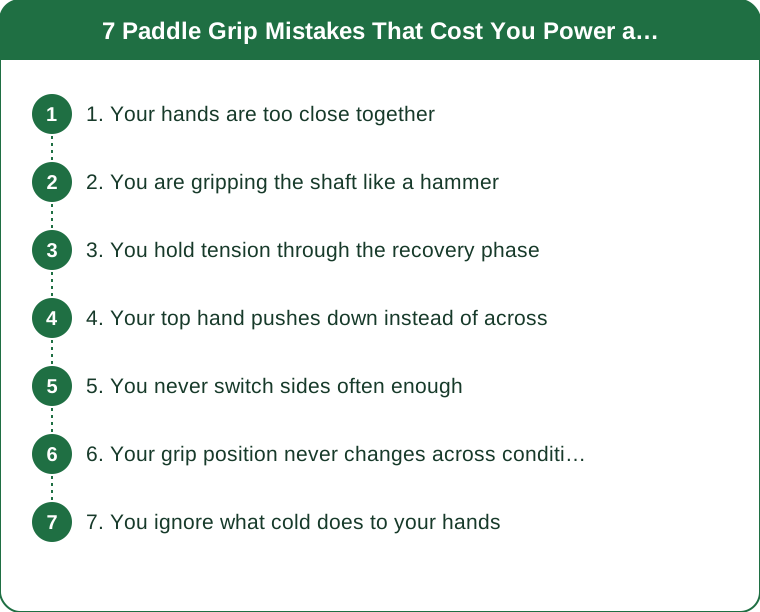
1. Your hands are too close together
This is the single most common error and it costs you leverage on every stroke.
The paddle is a lever and your hands are the fulcrum spacing. Narrow hands mean a short lever arm, which means your arms must supply force that the lever should have supplied for you.
The check: hold the paddle overhead with the shaft resting on your head. Your elbows should form roughly 90-degree angles. Most people find their hands are 4 to 6 inches too close when they do this for the first time.
What it feels like when corrected: wider feels awkward for about ten strokes and then the blade suddenly feels like it is catching more water for the same effort. That is the lever working.
Why people default to narrow: it feels more controlled and more stable, especially for beginners. Control is exactly what you trade power for.
Cost of getting it wrong: roughly 10 to 20 percent of your effective power, and a disproportionate share of the arm fatigue that ends sessions early.
2. You are gripping the shaft like a hammer
A tight grip is the fastest route to forearm pump and shoulder tension.
Grip force propagates upward. A clenched hand recruits the forearm, which recruits the upper arm, which loads the shoulder. You cannot have a relaxed shoulder and a white-knuckled hand at the same time.
Hooked fingers, not a closed fist. Think of your bottom hand as a hook holding the shaft in place, not a clamp squeezing it. The blade generates its force against the water, not against your palm.
The pump arrives faster than you expect. Sustained hard gripping restricts blood flow within the forearm, and once the pump sets in, grip strength drops sharply and everything upstream tightens to compensate.
Blisters are the giveaway. Blisters on the palm mean the shaft was moving against a tight grip. Correct grip pressure produces almost none.
Fix in the moment: consciously open your bottom hand fully for one second at the top of the recovery, every ten strokes. It resets both the grip and the tension pattern above it.
3. You hold tension through the recovery phase
Half of every stroke is a rest phase, and most paddlers skip it entirely.
The recovery is the return, not a second effort. Once the blade exits the water, there is nothing to grip against. Any tension held there is pure cost.
Over an hour that is thousands of unnecessary contractions. At roughly 30 strokes per minute, a 90-minute paddle is about 2,700 strokes. Holding tension through even half of each recovery is an enormous cumulative load.
This is the difference between a paddler who fades at 40 minutes and one who does not. It is rarely fitness. It is that one of them is genuinely resting for half of every second.
Practice cue: exhale on the recovery. Breathing out makes it physically harder to hold upper-body tension, so it enforces the relaxation automatically.
How to tell you are doing it: if your shoulders are tired but your legs and core are fresh after a session, you are paddling with your arms and never letting go.

4. Your top hand pushes down instead of across
The top hand direction is the most misunderstood element of the stroke.
Pushing down loads the shoulder at its weakest angle. A downward press with a raised arm puts the shoulder near the top of its range under load, which is the position most associated with impingement-type irritation.
The top hand should drive forward and across, roughly at eye to forehead height. The motion is more like punching forward than pressing down.
The blade does not need downward force. It needs to be planted and then held while your body rotates past it. Pressing down mostly just pushes the board’s nose down.
Height of the top hand sets stroke depth. Too low and the blade never fully buries; too high and you are pressing rather than driving. Eye level is the reliable landmark.
Shoulder pain check: pain at the front and top of the shoulder that shows up 30 minutes into paddling is the classic pattern for this error. Persistent shoulder pain deserves a professional look — this is general information, not medical advice.
5. You never switch sides often enough
Long stretches on one side build asymmetry that grip cannot compensate for.
Every stroke on one side is a small rotational load in one direction. Twenty minutes without switching means hundreds of repetitions in one pattern.
Switch every 5 to 10 strokes on flat water. More often than most recreational paddlers do, and it feels inefficient until you notice how much fresher you are at the end.
The switch itself should be quick and low. Lifting the paddle high to change sides costs both time and stability, and it is where a lot of beginners fall in.
Wind changes the math. Into a crosswind you will need more strokes on one side to hold a line. Accept the asymmetry but shorten the intervals, and switch during any lull.
The end-of-session tell: if one shoulder is consistently sorer than the other, your switching interval is too long for the distances you are covering.
6. Your grip position never changes across conditions
One hand position for all water is leaving speed and stability unused.
Narrow slightly in chop for control. Rough water rewards a quicker, shorter, more controlled stroke, and slightly narrower hands support that rhythm.
Widen for distance on flat water. Long steady efforts reward leverage, because the limiting factor is fatigue rather than reaction speed.
Choke down on the shaft into a headwind. Sliding the top hand lower reduces the effective blade leverage, which is what you want when wind is adding resistance to every stroke.
Mark your standard position with tape. A single wrap of tape at your default hand position lets you return to it instantly instead of re-finding it every session.
Fall conditions demand more adjustment. Colder water means more layers and reduced range of motion, and windier days mean more frequent changes — the paddler who adjusts grip through a session outlasts the one who sets it once.
7. You ignore what cold does to your hands
Late-season paddling changes grip mechanics before it changes anything else.
Cold reduces fine motor control before it reduces strength. Your ability to modulate grip pressure — to hold lightly — goes first, which pushes you back toward the death grip without you noticing.
Wet hands in wind lose heat fast. Evaporative cooling on a windy fall day drops hand temperature far faster than air temperature alone suggests, which is why an October paddle at 60 degrees can be harder on the hands than a 45-degree still day.
Warm hands before launching, not after. Thirty seconds of vigorous fist opening and closing on shore restores circulation that will take fifteen minutes to recover once you are cold on the water.
Paddling gloves are a real trade. They preserve warmth and cost you feel for grip pressure. For most fall paddling, thin gloves are worth it; for technique-focused sessions, they are not.
Turn around earlier than in summer. Cold hands losing grip control is a safety issue, not just a comfort one, and it degrades faster on the return leg when you are already tired.
TL;DR:
- Widen your hands to shoulder-width-plus; the overhead 90-degree elbow check finds it in seconds
- Hook the shaft, do not clamp it — grip tension travels straight up to the shoulder
- Actually relax during the recovery phase; it is half of every stroke and most people waste it
- Drive the top hand forward at eye level, not downward, to protect the shoulder
- Switch sides every 5 to 10 strokes and adjust grip width for chop, distance, and wind
- Cold hands lose grip control before grip strength — warm up on shore and turn back earlier in fall
None of these need a new paddle or a better board. Fix the two biggest ones — hand width and grip pressure — on your next session and the difference in how your shoulders feel afterward will be obvious the same day.
Keep Reading
This article is for general informational and styling purposes only. Fit, sizing, and product availability may vary.