7 Paddleboard Launch and Landing Mistakes That Ruin a Session Before It Starts
Quick Answer: Most bad SUP sessions are decided at the shoreline, not on the water. Launching too shallow damages the fin, launching with the board parallel to the waves guarantees a swim, and landing without a plan is where most boards get scratched and most ankles get twisted. The core sequence: walk the board out until it floats freely, point the nose into the wind or waves, mount on your knees, and reverse the exact same sequence to land.
Seven mistakes, in the order they usually happen.
Fix the first three and most of the rest stop mattering.
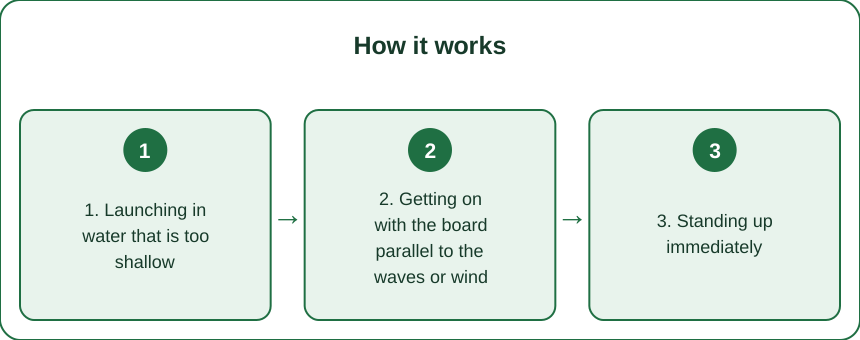
1. Launching in water that is too shallow
The most expensive habit on this list, and the most common.
Your fin hangs 8-10 inches below the board. Standing on the board in knee-deep water drives that fin straight into sand, gravel, or rock.
The damage is not always dramatic. Fin boxes crack slowly, and the leak shows up as a soft, waterlogged board weeks later. On an inflatable, a bent flexible fin looks fine and tracks noticeably worse.
The rule: walk the board out until it floats freely with no weight on it - usually mid-thigh to waist deep. Then mount.
How to check without guessing: push down on the center of the board with one hand. If the fin touches, you are too shallow.
2. Getting on with the board parallel to the waves or wind
A board sideways to any moving water is a board about to roll.
A paddleboard is enormously stable front-to-back and poor side-to-side. A wave hitting the rail lifts one edge, and there is nothing you can do about it from a kneeling position.
Always point the nose into the waves, or into the wind on flat water. The board pierces rather than gets lifted, and the wind stops trying to weathervane it out from under you.
On a lake with boat wake, watch for 20 seconds before you commit. Wake arrives in sets, and there is almost always a gap.
If you have to launch across a shore break, walk the board out past the break line first and mount beyond it. Never mount in the impact zone - that is where boards hit people.
3. Standing up immediately
The instinct is to get to your feet as fast as possible. It is backwards.
Mount on your knees, paddle out on your knees, and stand only once you are in open water with the board moving.
Two reasons. First, a moving board is more stable than a stationary one - the same gyroscopic effect that keeps a bicycle upright. Standing up on a stopped board is the hardest version of the skill. Second, near shore is where the depth is worst and the chop is most confused.
When you do stand: from the knees, feet where your knees were, hips over the center, and come up in one motion looking at the horizon. Looking down at the board is what makes people fall.
A useful drill: paddle 20 strokes on your knees before every single stand-up, whatever your level.
4. Leaving the leash for later - and 5. Dropping the paddle to mount
4. Not attaching the leash before you touch the water
The leash is the only thing that keeps a wind-blown board from separating from you at a speed you cannot swim. An unattached board in 15 knots of wind moves faster than a strong swimmer.
Attach it on shore, every time, as an unbreakable part of the routine. On rivers or any moving water, use a quick-release belt leash rather than an ankle leash - an ankle leash on a snag in current is a genuine entrapment hazard.
5. Putting the paddle down to get on
Everybody does this once. The paddle floats away in about four seconds and now you are a person on a board with no way to move.
Hold the paddle across the board, shaft under both hands, and use it as a brace as you mount. It is not just storage - a paddle laid flat across the deck gives you two extra points of contact and makes the whole mount steadier.
If you drop it anyway: lie down and hand-paddle. Do not stand up and try to reach.
6. Coming in too fast, and 7. Standing up to step off
6. Approaching the landing at speed
Boards get damaged on the way in far more often than on the way out, because you are tired and the beach looks like an ending rather than a maneuver.
Drop to your knees well before shore - 30 feet is not too early - and let the board glide. Kneeling drops your center of gravity right when the water gets shallow and confused.
Then step off into water deep enough to clear the fin, and walk the board in from beside it. Never let it surf in on its own.
7. Standing up on the board to dismount
The last ten seconds is where ankles get hurt. A standing dismount into unknown depth with a leash attached is an awkward step onto rocks you cannot see.
Sequence: kneel, swing one leg off into the water, feel the bottom, then step down. Slow and unglamorous.
Unclip the leash only once you are standing steadily, not before - a loose board in shore break is the thing that hits somebody.
What changes as the season turns
Late summer into fall shifts several of these from annoyance to genuine risk.
Water temperature drops behind air temperature. A pleasant 75-degree afternoon can sit over water in the low 60s. Cold-water shock on an unexpected fall is a real hazard well before anything looks like winter - and the launch and landing are exactly where unexpected falls happen.
Wind picks up in the shoulder season and shifts more often. The offshore breeze that helps you leave the beach is the one that makes returning hard. Always paddle out into the wind and back with it, never the reverse.
Days get shorter faster than people update their plans. A route that finished in comfortable light in August finishes at dusk in late September. Add 30 minutes of margin and carry a light.
Water levels drop in the fall on many lakes and rivers, exposing rocks that were not there in July. The launch you know may be shallower than it was, which sends you straight back to mistake number one.
Dress for the water, not the air. The standard guidance is that when air and water temperatures added together fall below about 120°F, a wetsuit belongs in the plan.
FAQ: SUP Launch and Landing Questions, Answered
Should I launch from a dock or from the beach?
A beach is easier and gentler on the board. From a dock, sit on the edge, place the board below you, and step onto the center while holding the dock - never step across a gap onto a floating board.
What if there is no way to get deep enough before mounting?
Use a shorter fin or, on an inflatable, remove the center fin for very shallow launches. Tracking suffers, and it beats cracking a fin box. Some inflatables also have flexible fins designed for exactly this.
How do I get back on after falling in deep water?
Swim to the center of the board at the side, grab the far rail, and kick hard while pulling yourself across on your stomach. Come on at the middle, not the tail - the tail sinks and the board flips. Practice it once in warm water before you need it in cold.
TL;DR:
- Walk out until the board floats freely before mounting - the fin hangs 8-10 inches down.
- Point the nose into the wind or waves. A board sideways to moving water rolls.
- Mount on your knees and paddle 20 strokes before standing; a moving board is a stable board.
- Leash on at the shore, paddle held across the deck - both before you touch the water.
- Land by kneeling early, stepping off in water deep enough to clear the fin, and unclipping last.
- In fall, dress for the water temperature, not the air, and add margin for early darkness.
Run the same sequence every session until it is automatic. The people who never damage a board are not more careful on the water - they are more careful in the first ninety seconds.
Keep Reading
This article is for general informational and styling purposes only. Fit, sizing, and product availability may vary.