7 Paddleboard Mistakes That Only Show Up on a Longer Distance Day
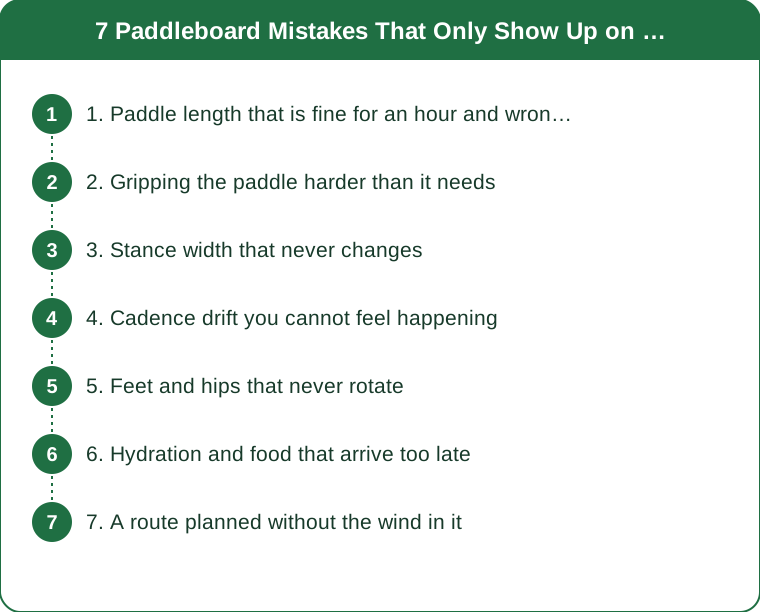
Quick Answer: Short paddles hide inefficiency because you have enough reserve to absorb it. Over two hours, small technique and setup errors compound into real fatigue, blisters, and a slow drift in your stroke that costs distance. The seven that show up most are paddle length, grip pressure, stance width, cadence drift, foot rotation, hydration timing, and route planning against wind. Almost all of them are fixed before you launch, not during.
Here they are in the order they usually appear on the water.
1. Paddle length that is fine for an hour and wrong for three
A paddle a few centimetres too long is nearly undetectable in a short session and is the leading cause of shoulder fatigue on a long one.
The mechanism is simple: an over-long paddle forces your top hand higher than shoulder height on every stroke. At around 40 strokes per minute, a two-hour paddle is roughly 4,800 strokes - a small overhead reach repeated that many times becomes a genuine shoulder problem.
The usual formula puts the handle somewhere around 20 to 25cm above your head for touring, and less for surf. But formulas assume average proportions. If you have a long torso relative to your height, or long arms, the formula will be wrong for you and the error only becomes obvious at distance.
The test that works: paddle for five minutes and notice where your top hand sits at the catch. If it is above your forehead, the paddle is too long for distance. For touring, a slightly shorter paddle than you would use for short sessions is usually better - it permits a higher cadence at a lower cost.
And if you have an adjustable paddle, use it. Shortening by 3cm for a long day is a real, immediate change. Most people set an adjustable paddle once and never touch it again, which throws away its entire advantage.
2. Gripping the paddle harder than it needs
Your grip should be light enough that you could be surprised out of it. Almost nobody’s is.
Over-gripping is invisible for the first half hour and then produces the classic forearm pump - a tight, burning fullness in the forearm that makes the hands feel weak and clumsy. It is a circulation problem caused by continuous muscle contraction restricting blood flow, and it is entirely self-inflicted.
The bottom hand should be a hook, not a clamp. The shaft rests in the fingers; the palm barely participates. The top hand should be an open palm over the handle, not a fist wrapped around it - many distance paddlers use a genuinely open hand with the palm on top.
Deliberately release between strokes. During the recovery phase, consciously loosen both hands for a moment. This restores blood flow and is the single most effective anti-pump measure available.
Check your grip every twenty minutes. Grip pressure creeps up unconsciously, particularly when conditions get choppy or you start concentrating. A quick check-and-release is worth setting a mental alarm for.
And gloves are usually the wrong answer. They reduce blister risk and often increase grip pressure because the feel is dulled. Tape on the specific hot spots is a better fix, and lets you keep the feedback that tells you when you are squeezing.
3. Stance width that never changes
A stance that is comfortable for an hour becomes a hip and lower back problem over three, because nothing has moved.
The issue is not the stance itself - it is the fixity. Standing in one position for two hours loads the same structures continuously, which is the same problem as standing still at work, on an unstable surface.
Shift your stance deliberately every 15 or 20 minutes. Slightly wider, slightly narrower, one foot marginally forward. These small changes redistribute load and are enough to prevent most of the accumulated stiffness.
Learn a staggered stance and use it in wind. One foot slightly back gives far better fore-aft stability and lets you drive the stroke with more hip rotation. On flat water it is optional; in a headwind or chop it is the difference between paddling and surviving.
And kneel occasionally, on purpose. Kneeling for five minutes every hour rests the standing muscles entirely, lowers your wind profile, and lets you eat and drink properly. Distance paddlers do this routinely; recreational paddlers treat it as an admission of defeat, which costs them the second half of the day.
Your feet should also move. Small pivots and weight shifts prevent the specific foot fatigue - that dull ache across the arch - that most people accept as inevitable.
4. Cadence drift you cannot feel happening
Your stroke rate falls slowly and your stroke gets longer to compensate, which is less efficient and harder on the shoulder.
This is the classic distance failure mode and it is almost impossible to notice from inside. You feel like you are working at the same rate. In fact your cadence has dropped and you are pulling harder and longer on each stroke to maintain speed - which loads the shoulder more and produces more fatigue for the same distance.
The fix is to know your cadence and check it. Count strokes for 30 seconds every half hour. A drop of more than a few strokes per minute means you are drifting, and the correction is to shorten the stroke and pick the rate back up rather than pulling harder.
Exit the stroke at your feet. Almost everyone pulls past the hips as they tire, which is the least efficient part of the stroke - you are lifting water rather than moving the board. The cue is to take the blade out when it reaches your foot, and it becomes more important the more tired you get.
Switch sides on a count, not on feel. Every 8 to 12 strokes, consistently. Switching when one side gets tired means you are already imbalanced, and the fatigue difference compounds across a long day.
And accept a slightly slower average. A sustainable cadence held for three hours covers more distance than a strong one held for ninety minutes and abandoned.
5. Feet and hips that never rotate
Paddling with the arms alone is possible for an hour and impossible for three.
The stroke should be driven by rotation through the torso, with the arms transmitting rather than generating force. When people tire, they revert to arm-only paddling - which is weaker, slower, and much more fatiguing.
The check is your chest. At the catch, your chest should be rotated toward the paddle side. If your shoulders stay square to the nose of the board through the whole stroke, you are paddling with your arms, and the shoulder is doing work the core should be doing.
Hip rotation follows chest rotation. Allow the hips to unwind slightly as the stroke progresses. This is what makes the stroke feel long without over-reaching, and it is where most of the actual power comes from.
Foot pressure is part of it. Pressing gently into the forward foot at the catch and the back foot at the exit anchors the rotation. Feet that stay passive make rotation impossible.
And this is trainable off the water. Cable rotations, Pallof presses, and any anti-rotation core work transfer directly. The people who fade least at distance are almost always the ones with the most core endurance, not the strongest shoulders.
6. Hydration and food that arrive too late
By the time you feel thirsty on the water, you are already behind - and standing paddling makes it easy to postpone indefinitely.
The practical problem is access. If your water is in a dry bag strapped down at the nose, you will not drink it. Every drink requires kneeling, unclipping, and restowing, so you decide you are fine. A bottle in a deck bungee within arm’s reach changes behaviour completely.
Drink on a schedule, not on thirst. Roughly every 20 minutes from the start. Sun on water, reflected glare, and steady effort produce more sweat loss than the sensation suggests, particularly since a breeze evaporates it before you notice.
Eat before you need to, at around 60 to 90 minutes. Something simple and easy to handle one-handed. The energy dip on a long paddle arrives fast and takes 20 minutes to recover from, which on open water can be 20 minutes you needed.
Salt matters in warm conditions. Water alone over three hours of sweating can leave you worse off. A pinch of salt in the bottle or salty food beforehand covers it.
And plan the kneeling breaks around it. Five minutes on your knees every hour to drink, eat, check the map, and rest the legs is a genuine strategy - not a failure of stamina.
7. A route planned without the wind in it
The single biggest determinant of how a long paddle goes is whether the wind is behind you at the start or the end.
The classic mistake is to paddle out with a tailwind because it feels wonderful. You cover distance easily, you go further than planned, and then you turn into a headwind with two hours of fatigue in your shoulders. This is how most genuinely bad days on the water happen.
Always paddle into the wind first. It is unpleasant and it is correct. The return leg with the wind behind you is easier precisely when you need it to be, and your effective range is set by your outbound capacity in the harder direction.
Check the forecast for wind change, not just wind speed. An offshore breeze that builds through the afternoon is the standard late-summer pattern in many places, and a morning that starts calm can be a 15 knot afternoon.
Never paddle out on an offshore wind you could not paddle back against. Offshore wind is the highest-risk condition for paddleboards because it is deceptively calm near the shore and much stronger further out.
And have a bail-out. A known landing point halfway, or a route that hugs a shoreline you could walk from. A long paddle with no exit option is a much bigger commitment than the distance suggests.
Wear your leash, carry a means of calling for help in a waterproof pouch, and tell someone your plan and expected return time. As water and air temperatures start diverging into autumn, the consequences of an unplanned swim change considerably - check both, not just the air.
TL;DR:
- Paddle length that is fine for an hour wrecks shoulders over three - shorten for distance, and use your adjustable paddle.
- Grip like a hook, not a clamp, and consciously release between strokes to prevent forearm pump.
- Change stance every 15 to 20 minutes and kneel for five minutes an hour on purpose.
- Cadence drifts down without you noticing - count strokes every half hour and exit the blade at your feet.
- Rotate the chest and hips, or the shoulders will do work they cannot sustain.
- Drink every 20 minutes from a reachable bottle, eat at 60 to 90 minutes, and take salt in warm conditions.
- Paddle into the wind first, always, and never launch on an offshore wind you could not return against.
Distance does not demand new skills. It just runs the old ones long enough for the errors to show - which makes almost all of this a pre-launch checklist.
Keep Reading
This article is for general informational and styling purposes only. Fit, sizing, and product availability may vary.