7 Paddleboard Mistakes That Only Show Up When You Paddle With Someone Else
Quick Answer: Paddling alongside someone forces you to match a cadence that is not yours, look sideways while paddling, and hold a line relative to another moving object. Each of those quietly breaks a piece of technique that works fine solo. The result is more shoulder load, more course correction, and a session that is harder than the distance suggests.
You paddle alone most of the time and it goes well. Then a friend joins you and the whole thing feels wrong — you are working harder, drifting into each other, and your shoulders complain by the end.
Neither of you is a worse paddler than you were last week. Paddling in company is simply a different skill, and it exposes seven specific habits that solo paddling lets you get away with.

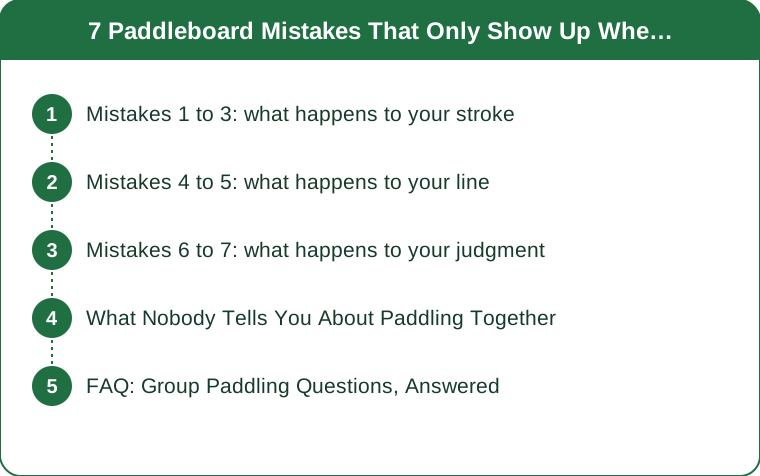
Mistakes 1 to 3: what happens to your stroke
1. You match their cadence instead of your own
Stroke rate should follow your board length, paddle length, and height. Matching someone with a different setup means paddling at a rate that does not fit your equipment.
The tell: you feel like you are rushing, or like you are waiting between strokes. Rushing means you are cutting the catch short and losing most of the power phase; waiting means you are gliding past the point where speed has dropped, then having to rebuild it.
The fix: match position, not cadence. Agree to stay level with each other and let each person use their own stroke rate. Two paddlers at different rates can hold the same speed perfectly well, and it is far less tiring than forcing a match.
2. You switch sides less often
Solo, you switch every four to six strokes without thinking, because the board tells you to. In conversation, switching interrupts the rhythm of talking, so people delay it — often to ten or twelve strokes.
The cost is entirely one-sided. One shoulder does double duty for the session, which is the actual reason your shoulders hurt more after a social paddle than a solo one of the same distance.
The fix: count out loud, or agree a switch signal. Five strokes per side, alternating, regardless of conversation.
3. You paddle with your head turned
Talking to someone beside you means rotating your head, and head position drives torso position. A turned head opens the shoulders toward your partner, which shortens your reach on one side and lengthens it awkwardly on the other.
The tell: the board drifts steadily toward your partner and you keep correcting.
The fix: talk forward, not sideways. It feels rude for about two minutes and then feels normal, and it is what everyone who paddles regularly in groups ends up doing.
Mistakes 4 to 5: what happens to your line
4. You steer with the paddle instead of the board
Trying to hold a line relative to a moving partner produces constant small corrections, and most people make them with a sweeping paddle stroke. Sweeps are slow, they cost speed, and they load the shoulder in its weakest position.
The better tool is your feet. Small shifts of weight toward the heels or the toes turn the board with no loss of speed, and no shoulder cost at all. This is a genuine skill and it takes a few sessions to develop, but it transforms group paddling.
The drill: paddle in a straight line without switching sides, using only foot pressure to hold your course. Fifty strokes per side. It is harder than it sounds and it builds exactly the control that group paddling demands.
5. You paddle in their wake without noticing
Directly behind another board is disturbed water, and it is measurably harder to paddle in. Slightly off to the side and behind is the opposite — you can catch a small assist from their wake, which is why racers pay attention to it.
The tell: you are working harder than usual to hold a position you thought was easy.
The fix: stay level, or offset by half a board length to the side. Never sit directly behind, which is both the hardest place to paddle and the worst place to be if they stop suddenly.
The spacing rule: two paddle lengths of lateral separation is the minimum. Closer than that and you both spend the session steering around each other.

Mistakes 6 to 7: what happens to your judgment
6. You go further than either of you planned
Two people talking lose track of distance and time in a way one person does not. The turnaround point drifts, and it drifts specifically because conversation is pleasant and nobody wants to be the one to call it.
This matters more on water than on land. The return leg is frequently harder — wind typically builds through the afternoon, and an outbound leg with a following breeze becomes a headwind coming home. Going 30 percent further than planned on the way out can easily mean 60 percent more effort on the way back.
The fix: agree a turnaround time before launching, not a distance, and set an alarm. Time is the honest measure because it accounts for conditions automatically.
7. You stop checking conditions
Solo paddlers watch the water constantly, because there is nothing else to attend to. In company, that attention goes to the conversation.
What gets missed: the wind picking up, the surface texture changing, cloud building, the drift of your position relative to the shore. All of these are obvious to someone watching and invisible to someone talking.
The fix: assign it. One person is the designated conditions-watcher for the first half, the other for the second. It sounds excessively formal and it takes ten seconds to agree, and it is the single most useful safety habit for social paddling.
Late-season note: this matters more in autumn. Water temperature is dropping, afternoon wind builds earlier, and daylight is shorter. An unplanned extra thirty minutes in September has consequences that the same thirty minutes in July does not.
What Nobody Tells You About Paddling Together
A social paddle and a training paddle are different sessions, and trying to make one do both is why people come home frustrated.
A social paddle has conversation as the point. Distance is incidental, technique will degrade, and that is fine. Plan it as a shorter route than you would do alone, expect to be slower, and do not track it against your solo times.
A training paddle in company works only if you agree in advance that talking is limited — intervals, or a set distance at a set effort, with conversation at the turnarounds. Most people find this awkward to propose and are relieved when someone else does.
The mistake is the unspoken hybrid, where one person wanted a workout and the other wanted a chat. Both end up mildly dissatisfied and neither says so.
A practical structure that works for mixed groups: paddle out in silence at your own pace and regroup at a landmark, then paddle back together and talk. Everyone gets the session they wanted, in the order that suits the conditions — because the outbound leg is when you are freshest and the return is when conversation genuinely helps.
FAQ: Group Paddling Questions, Answered
How far apart should we actually be?
Two paddle lengths laterally as a minimum, and level rather than staggered. Close enough to talk at a normal volume, far enough that neither of you is steering around the other. Closer than that and you will both spend the session making corrections.
Should a beginner lead or follow?
Lead, always. A beginner following sets their pace by someone else’s and ends up in disturbed water while trying to keep up. A beginner in front sets a sustainable pace and the more experienced paddler can watch their technique and adjust position freely.
Why do my shoulders hurt more after a social paddle?
Almost always the side-switching problem. Count your switches on the next one — most people find they have gone from switching every five strokes to every ten or more without any awareness of it, which doubles the work on one side.
Does any of this apply to paddling with a dog on board?
Some of it, particularly the steering and the constant small corrections. The head-turning problem is worse, since you will be checking on them constantly. Foot steering matters even more, because your hands are busy and your weight distribution is no longer entirely yours to control.
TL;DR: Company changes the sport more than it changes the distance.
- Match position, not cadence — two paddlers can hold the same speed at different stroke rates.
- Switching sides less often is the reason your shoulders hurt; count them, five per side.
- Talk forward rather than sideways, or your board follows your head.
- Steer with your feet, not with sweep strokes — the drill is fifty strokes per side holding a line without switching.
- Stay level or offset, never directly behind.
- Agree a turnaround time before launching, and assign someone to watch conditions.
Decide before you launch whether it is a social paddle or a training paddle. The unspoken hybrid satisfies nobody.
Keep Reading
This article is for general informational and styling purposes only. Fit, sizing, and product availability may vary.