7 Paddleboard Mistakes That Only Show Up in Choppy Water
Quick Answer: Chop exposes seven habits that flat water forgives: a stiff lower body, eyes on the board, a short choppy stroke, a narrow stance, a death grip, paddling only on one side, and standing too far back. Fix the stance and the eyes first — they solve about half the problem on their own.
You can paddle a mirror-flat morning lake for an hour without falling. Then a boat wake rolls through and suddenly you are auditioning for a blooper reel. The chop did not make you worse. It just stopped hiding what was already there.
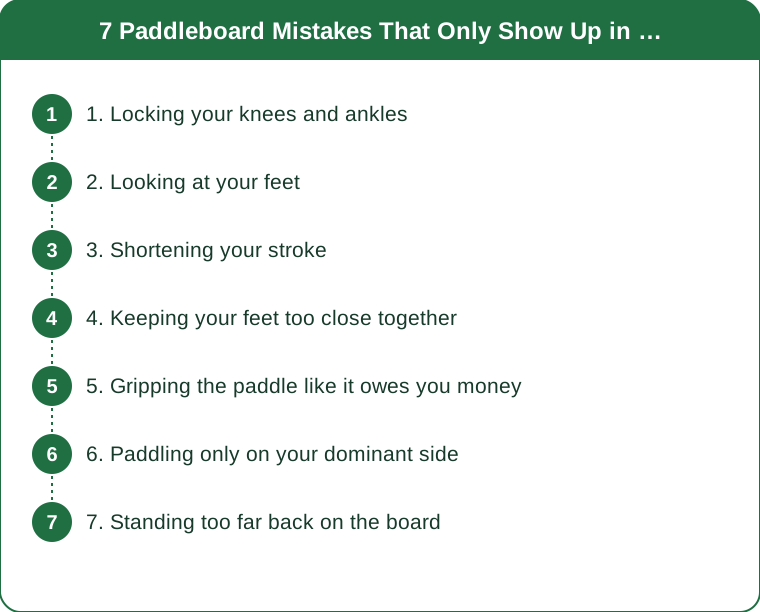
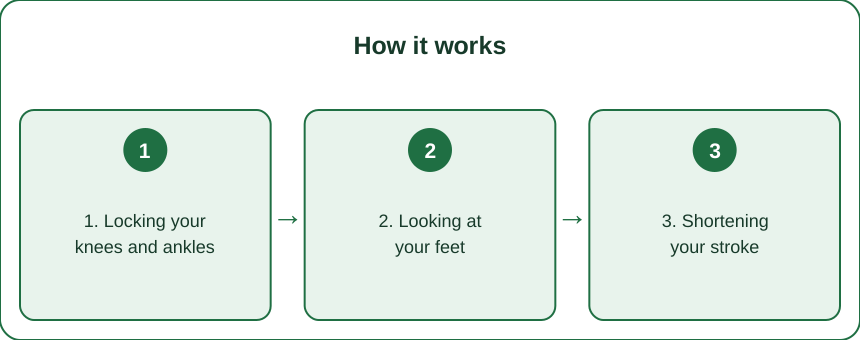
1. Locking your knees and ankles
On flat water a stiff lower body is fine, because there is nothing to absorb. In chop it is the single biggest cause of falls.
Your board is going to move. The question is whether your ankles, knees, and hips absorb that movement or transmit it to your center of mass. Locked joints transmit everything.
The fix is a soft, springy stance with knees unlocked about 10 to 15 degrees — the same amount you would use skiing or riding a subway car standing up. Let the board move underneath you while your head stays relatively still. If your head is bobbing with every wave, your legs are not doing their job.
2. Looking at your feet
The instinct when you feel unstable is to look down and check on the situation. This makes it worse in two ways.
Dropping your head shifts your weight forward and reduces the range your balance system has to work with. More importantly, your inner ear stabilizes against a horizon reference, and you just took it away.
Look at a fixed point 20 to 30 feet ahead, or at the shoreline. Chop feels dramatically less threatening when you are not watching each individual wave arrive.
This is also why paddlers often report that chop feels worse in fog or glare. The problem is not the water, it is the missing reference.
3. Shortening your stroke
Nervous paddlers take short, fast, shallow strokes. It feels like control. It is the opposite.
A short stroke means the paddle is out of the water more often, and your paddle in the water is a third point of contact — a brace, effectively. More time in the water is more stability, not less.
In chop, reach further forward, get the full blade buried, and pull to your ankle. Slower cadence, longer purchase. If you are genuinely unstable, plant the blade and leave it there for a beat before pulling. That pause is a legitimate technique, not a mistake.
4. Keeping your feet too close together
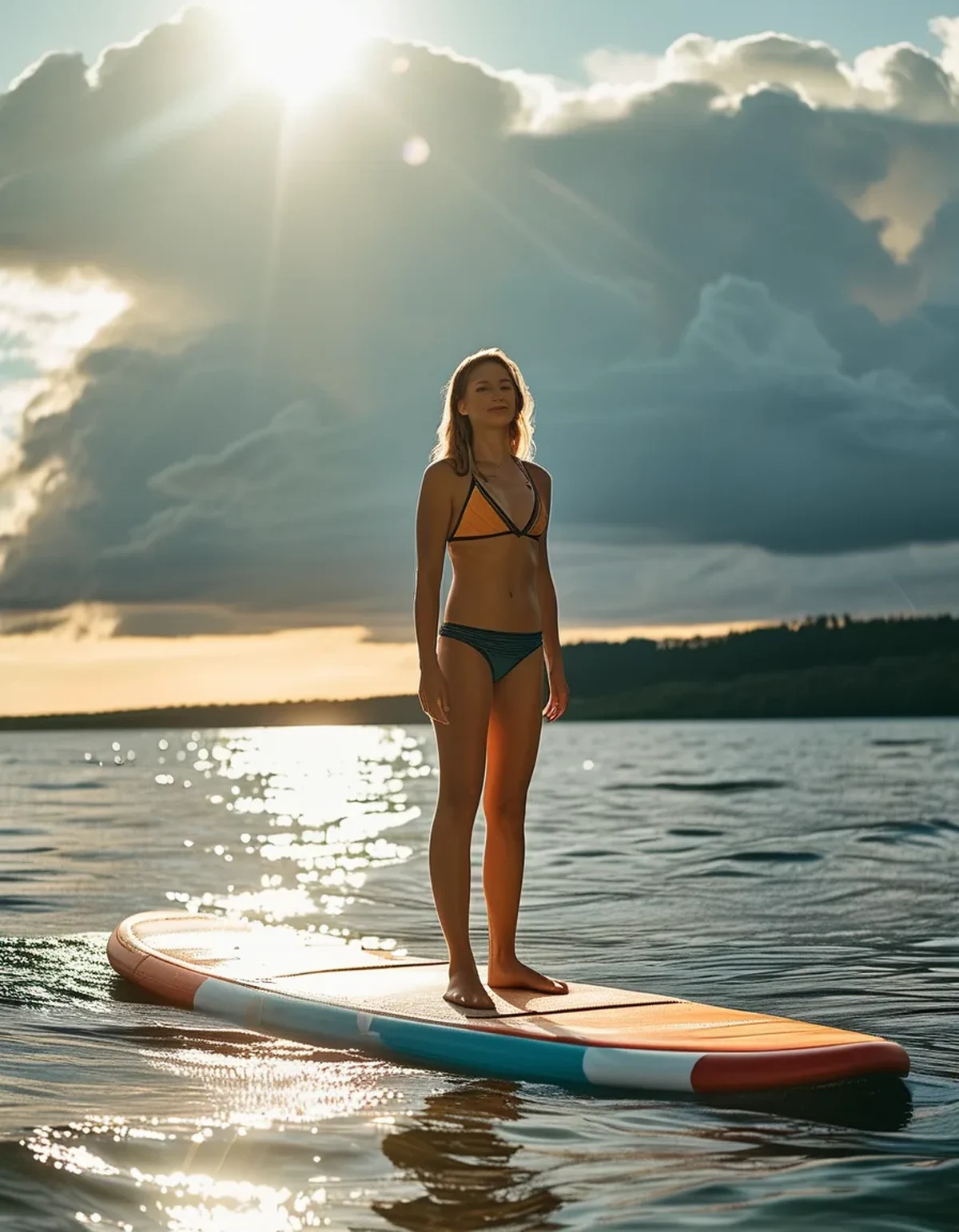
Most people paddle with feet roughly hip-width and parallel. That is a fine flat-water stance and a poor chop stance, because it gives you almost no side-to-side base.
Widen to roughly shoulder width or slightly beyond, and stagger one foot two to four inches forward. The stagger matters: it gives you a fore-aft base as well as a lateral one, and boat wakes tend to hit at an angle rather than square.
In heavy chop, some paddlers move to a full surf stance with one foot clearly forward. That is worth practicing on calm days so it is available when you need it.
5. Gripping the paddle like it owes you money
A tense grip travels. Tight hands mean tight forearms, tight shoulders, and a rigid trunk — and a rigid trunk cannot make the small corrections that keep you upright.
Hold the shaft firmly enough not to lose it and no firmer. Many coaches use the cue of holding it like a bird you do not want to crush or release.
There is a practical side effect: a relaxed grip lets the paddle rotate slightly in your hand as the blade catches uneven water, which stops small catches from becoming a lever that pulls you over.
6. Paddling only on your dominant side
In flat water you can go ten strokes on one side and correct with a sweep. In chop, that means ten strokes with no brace available on the other side, and wakes are not polite about which side they arrive on.
Switch every three to five strokes when conditions are rough. It costs a little efficiency and buys a lot of stability, because you are never far from having a blade in the water on the side you need.
If switching feels clumsy, that is a flat-water drill worth doing: paddle a calm loop switching every three strokes until the hand change stops requiring thought.
7. Standing too far back on the board
As people get nervous, they drift backward, usually without noticing. It feels safer to be near the tail.
What it actually does is lift the nose. A lifted nose catches wind, gets pushed sideways, and slaps down on every wave. You end up fighting the board’s direction on top of fighting your balance.
Stand so the board sits level, with the nose just kissing the water — usually with the carry handle between your feet. In chop, some paddlers move slightly forward of neutral so the nose stays down and cuts rather than slaps.
Check it by looking at the wake behind you, not by looking down at your feet. A board that is trimmed right leaves a clean line.
TL;DR:
- Soften your ankles and knees so the board moves and your head does not
- Eyes on the horizon, never on your feet
- Longer strokes with the blade fully buried give you a built-in brace
- Widen and stagger your stance, relax your grip, switch sides every few strokes, and check your trim
The fastest improvement here comes from the two cheapest fixes: widen your feet and lift your eyes. Do those on your next windy afternoon and the other five get noticeably easier, because you will no longer be spending all your attention on not falling in. Practice them on calm days so they are automatic on the day a wake finds you sideways.
Keep Reading
This article is for general informational and styling purposes only. Fit, sizing, and product availability may vary.