7 Storage and Transport Mistakes That Quietly Wreck a Paddleboard
Quick Answer: The three biggest killers of paddleboards are heat, pressure points and UV, and all three do their work off the water. An inflatable left fully inflated in a hot car can exceed safe seam pressure; a hard board strapped too tight on a rack develops permanent compressions; and stored outdoors, UV degrades both PVC and epoxy finishes within a couple of seasons. Correct storage costs nothing and roughly doubles usable board life.
You rinse it. You dry it. You think you are doing the right things.
Then you leave it strapped to the roof in an August car park for four hours, and that is the day the damage actually happens.
Here are the seven that matter, roughly in order of how much they cost you.

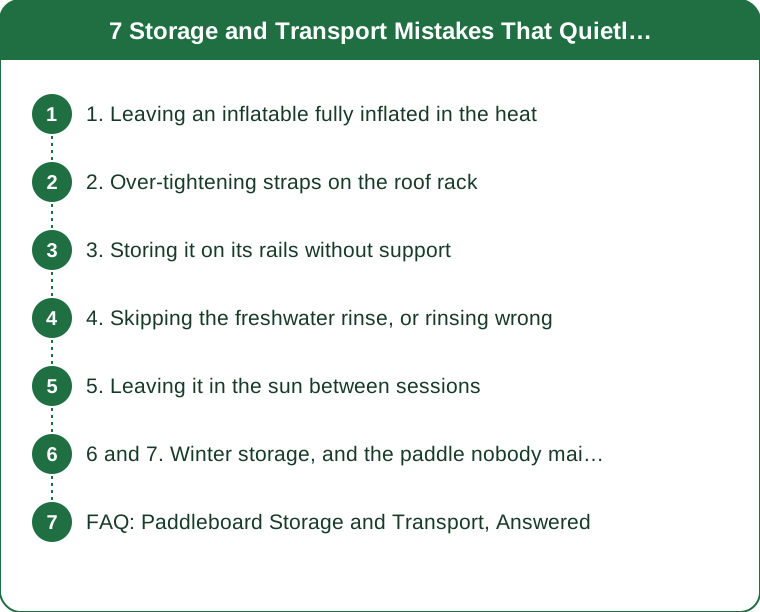
1. Leaving an inflatable fully inflated in the heat
This is the most expensive mistake on the list and the easiest to make.
Air pressure rises with temperature. A board inflated to 15 PSI in cool morning air can climb several PSI sitting in direct sun or inside a closed car, and closed cars reach far higher temperatures than the air outside them.
Seams fail before the material does. The drop-stitch core and the glued rail seams are the weak points, and over-pressure damage is often invisible until the board delaminates.
The fix is trivial. If the board is staying inflated in heat, drop it to around 10 to 12 PSI and top it up before use. If it is going in a car for hours, deflate it.
Never leave it inflated in a hot car boot. This is the single most common way inflatable boards die.
Shade beats ventilation. If you must leave it inflated outdoors, get it out of direct sun. A light-coloured cover works; a dark one makes it worse.
Check pressure at temperature. Reading PSI on a cold morning and assuming it holds all day is how people end up well above the rated maximum by afternoon.
2. Over-tightening straps on the roof rack
Tight feels safe. It is not.
Compression creates permanent dents. On a hard board, over-tightened straps deform the deck and rails, and epoxy does not fully recover. On an inflatable, sustained compression at a single point stresses drop-stitch fibres.
The target is snug, not crushing. The board should not shift when you push it firmly by hand. Beyond that, you are only adding damage.
Use pads under every contact point. Foam pads spread the load. Bare crossbars concentrate all the pressure into two thin lines.
Two straps, not one. One strap has to be tighter to do the same job. Two moderate straps hold better and compress less.
Twist the straps once. A single twist in each strap stops the loud harmonic vibration at speed. That vibration is not just annoying, it works straps loose.
Check after 10 minutes of driving. Straps settle. The second check is what stops boards moving on the motorway, and it takes 30 seconds.
3. Storing it on its rails without support
Where a board rests decides where it deforms.
Flat on the ground is worst. It puts the entire weight on whatever debris happens to be under it, and creates pressure points on the deck or hull.
On the rails is best, with wide support. Vertical or on-edge storage with padded supports at the one-third and two-thirds points distributes load correctly.
Never store nose or tail down on hard ground. Concentrated weight on one end is a reliable way to damage a nose.
Straps or slings, not narrow hooks. Wide webbing spreads pressure. A narrow hook over months leaves a permanent mark.
Deflated and rolled loosely for inflatables. Rolled tight around a fixed radius for a whole winter creates creases that never fully relax. Roll loosely, or store it lightly inflated at 2 to 3 PSI.
Keep weight off the deck. Garages accumulate things on flat surfaces. A board is not a shelf, and the thing you put on it in October will still be there in April.

4. Skipping the freshwater rinse, or rinsing wrong
Salt is obvious. The less obvious ones do more damage.
Salt crystals are abrasive. Dried salt in a fin box or a leash plug grinds every time the part moves.
Fresh water needs rinsing too. Lake and river water carries silt and organic matter that dries into an abrasive film, and in some regions rinsing is also a biosecurity requirement to prevent transporting invasive species between waterways.
Rinse the fin box and leash plug specifically. These are the parts that seize, and they are the parts everyone skips.
Dry before storage, always. Trapped moisture inside a rolled inflatable produces mould that is essentially impossible to fully remove, and it will smell for the rest of the board’s life.
Open the valve when storing rolled. Sealed damp air is the exact condition mould wants.
Do not use hot water or solvents. Warm fresh water and a soft cloth is all that is required, and anything stronger attacks PVC glue and epoxy finishes.
5. Leaving it in the sun between sessions
UV is slow, cumulative and completely invisible until it is not.
PVC becomes brittle. UV degrades plasticisers, so the material stiffens, and stiff PVC cracks at fold points.
Epoxy yellows and chalks. Hard boards lose gloss first, then the surface becomes powdery, which is the finish breaking down rather than dirt.
Colour fades unevenly. Only the exposed side changes, which is a good visual reminder of how localised the damage is.
Two seasons is enough to matter. Boards stored outdoors uncovered typically show clear UV damage within two summers.
A cover is cheap insurance. A light-coloured, breathable cover costs a fraction of a board and solves it entirely.
Beach breaks count. A board sitting on sand for a three-hour lunch is getting reflected UV from below as well as direct sun from above. Flip it deck-down or park it in shade.
6 and 7. Winter storage, and the paddle nobody maintains
6. Winterising it in an unheated space, badly
Cold itself is not the enemy. Cycling between cold and warm is.
Repeated freeze-thaw stresses seams. An inflatable stored in a shed that swings between freezing nights and warm afternoons works its glue joints all winter.
Store slightly inflated rather than tightly rolled. 2 to 3 PSI keeps the material relaxed without stressing seams as temperature changes.
Rodents like drop-stitch material. A garage board should be off the floor and, ideally, in a bag. This is a more common cause of winter damage than most people expect.
Remove the fin. Fin boxes crack when a fin is knocked in storage, and a removed fin cannot be knocked.
Loosen everything. Leash off, valve open, straps undone. Anything under sustained tension for five months takes a set.
Autumn timing note: the end of the paddling season is exactly when people are least motivated to do this properly, which is why so much damage is discovered in spring. Twenty minutes in October is the highest-value maintenance of the year.
7. Ignoring the paddle entirely
The board gets all the attention. The paddle is what actually fails mid-session.
Adjustable joints seize. Salt and grit in a telescoping shaft is the number one paddle failure, and a rinse prevents it completely.
Carbon shafts do not like clamp pressure over time. Store adjustable paddles with the clamp released, not locked at length.
Blade edges chip from ground contact. Standing a paddle blade-down on concrete between sessions does slow, cumulative damage. Lean it blade-up.
Heat warps blades. A paddle across a hot car parcel shelf in August is a genuinely bad idea for a composite blade.
Check the ferrule pin annually. A worn pin turns into a paddle that separates mid-stroke, which is the closest thing to a real safety issue on this list.
And store it with the board. The most common paddle problem is not damage at all, it is arriving at the water without it.
FAQ: Paddleboard Storage and Transport, Answered
Can I leave my inflatable inflated all season?
Yes, if it is out of direct sun and at a reduced pressure of around 10 to 12 PSI. Full pressure plus heat is where the risk is.
Is roof transport worse than inside the car?
No, if done correctly with pads, two moderately tightened straps and a check after ten minutes. Inside is only better because it avoids UV and wind.
Deck up or deck down on the rack?
Deck down for hard boards, which protects the more delicate deck surface and reduces lift.
How tight should straps be?
Snug enough that the board does not shift under a firm push, and no tighter. Compression damage is invisible until it is permanent.
Should I store a hard board flat or on edge?
On edge, supported at the one-third and two-thirds points with padded supports.
How long should a well-kept board last?
A quality inflatable stored properly commonly gives 5 to 8 seasons. The same board left inflated in sun and heat frequently shows failure in two.
TL;DR:
- Heat, pressure points and UV cause most board damage, and all three happen off the water.
- Never leave an inflatable at full pressure in a hot car; drop to 10 to 12 PSI or deflate.
- Straps should be snug, not crushing, with pads at every contact point and a re-check after ten minutes.
- Store on edge with wide support, deflated loosely or at 2 to 3 PSI, valve open and dry.
- Rinse the fin box and leash plug, cover against UV, and release the paddle clamp.
Do the October twenty-minute version properly and you will not spend April buying a new board.
Keep Reading
This article is for general informational and styling purposes only. Fit, sizing, and product availability may vary.