7 Paddleboarding Mistakes That Only Show Up Once the Wind Picks Up
Quick Answer: Calm water hides technique errors because there is nothing pushing back. Wind exposes them all at once, and the seven that cause the most trouble are: standing too upright, paddling from the arms, holding the paddle wrong, drifting downwind before you notice, ignoring the fin, going out on the wrong tide-and-wind combination, and not knowing the one recovery position that turns a dangerous situation into an inconvenient one. Here they are in the order they usually bite.
Everybody’s first windy paddle is a shock. The board goes sideways, the paddle catches, and the shore you left gets further away while you work harder.
None of that is a strength problem. It is seven fixable things.
1. Standing too upright, and 2. Paddling with your arms
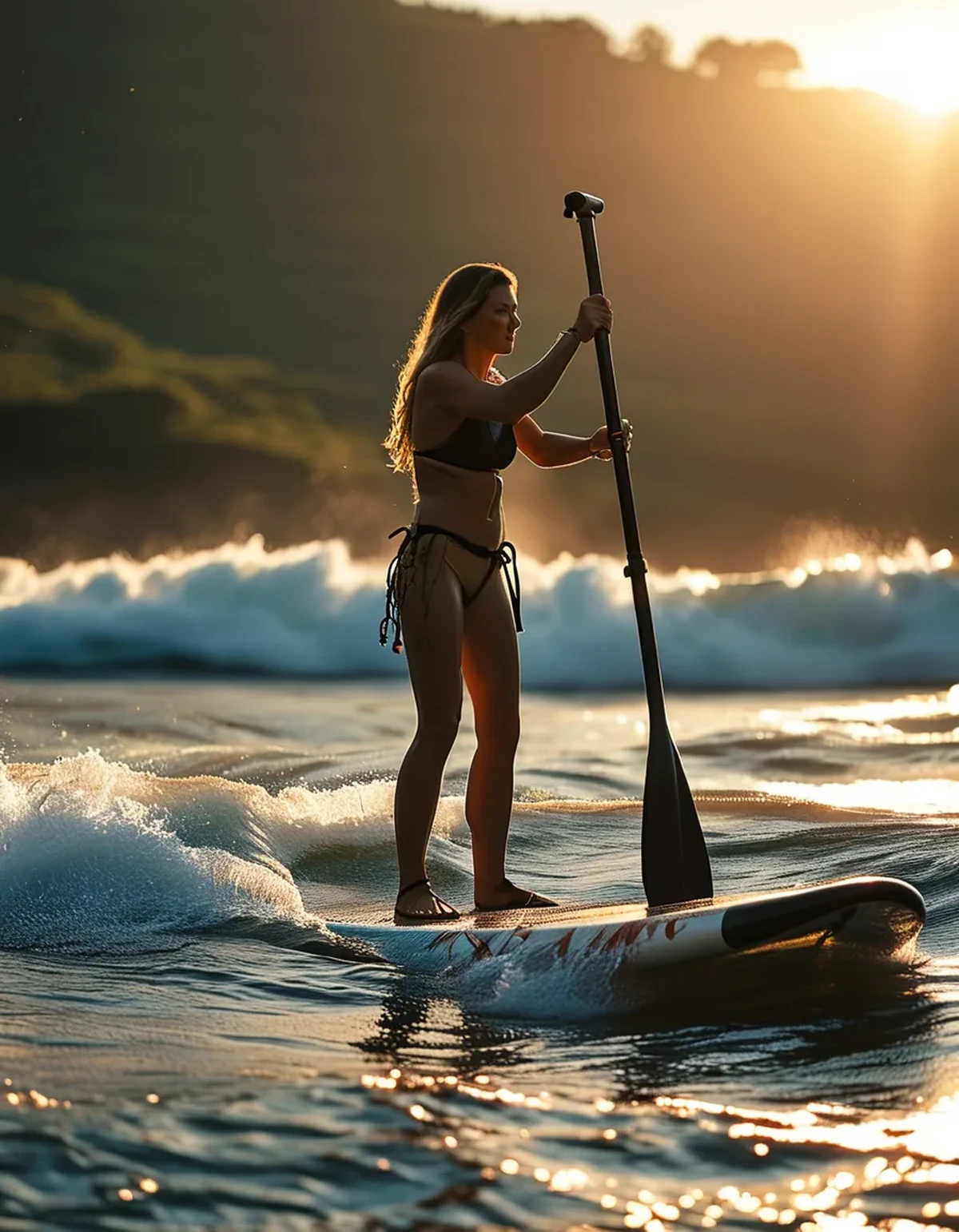
Mistake one: standing tall. On flat water, an upright posture is comfortable and stable enough. In wind and chop it is the worst possible stance for two reasons — a high centre of gravity magnifies every wobble, and your whole body becomes a sail.
The fix is a soft athletic stance: knees unlocked and slightly bent, hips back a little, weight through the middle of your feet, eyes on the horizon rather than on the board. Bent knees let your legs act as suspension, which is what actually keeps you upright in chop.
In stronger wind, drop lower still, or drop to your knees entirely — which is not a failure, it is the correct technique when the wind wins.
Mistake two: pulling with the arms. Almost every beginner paddles with the arms, and on flat water it works for a while.
In wind it fails within ten minutes, because arms are small muscles and they fatigue fast against resistance. The power should come from rotating your torso, with the arms staying relatively straight and acting as connections rather than engines.
The cue that fixes it fastest: think about pulling the board past the paddle, rather than pulling the paddle through the water. Plant the blade, rotate, and let your core do the work. Your top hand pushes forward rather than your bottom hand pulling back.
If your shoulders and biceps are what hurt after a paddle, this is the mistake you are making.
3. The paddle is probably backwards, and 4. You are drifting before you know it
Mistake three: blade angle. This is the most common single error in the sport, and it is counterintuitive enough that most people get it wrong on their own.
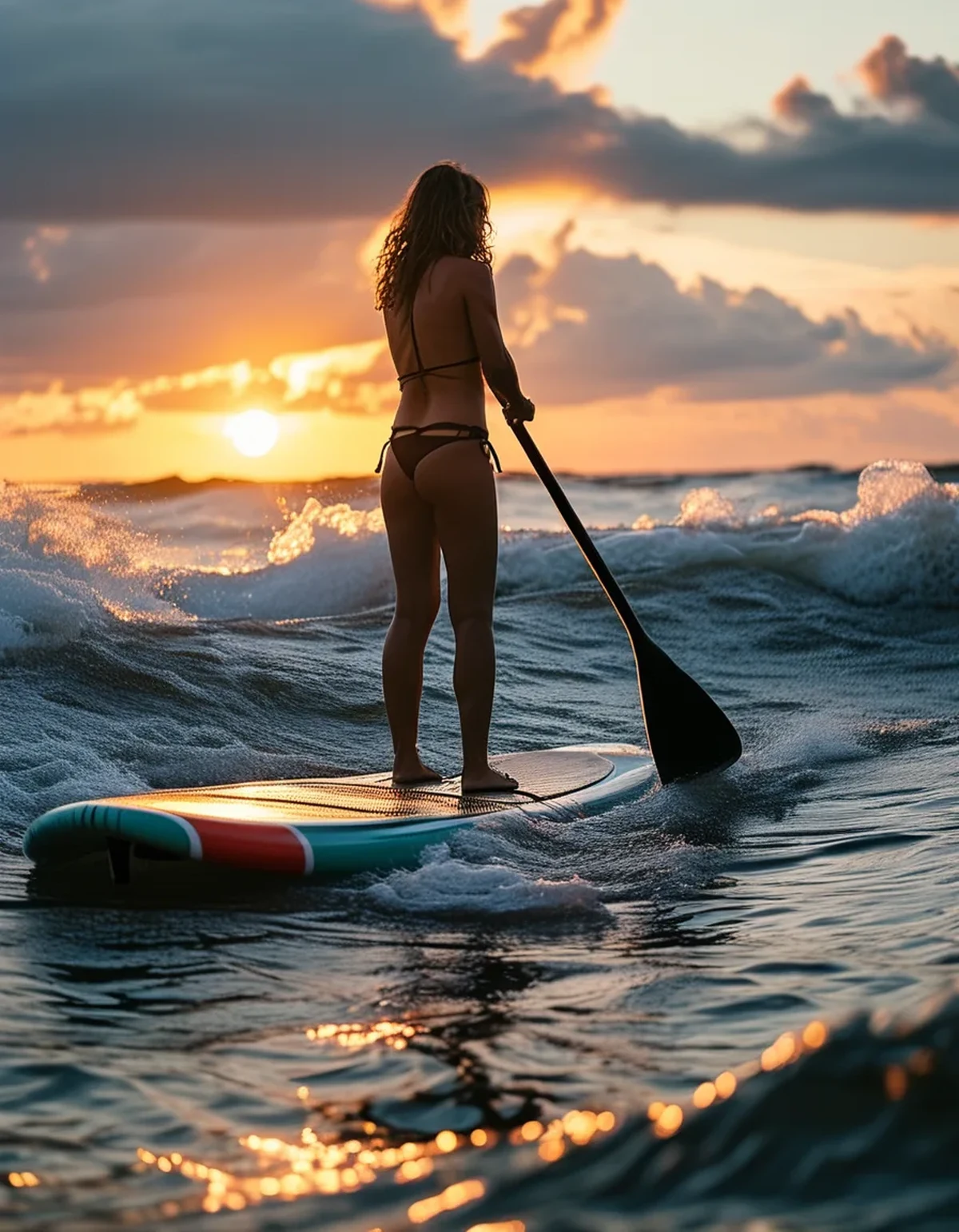
The blade angles forward, away from you, not back toward you. It looks wrong. It feels wrong. It is correct, and the reason is that the forward angle keeps the blade vertical and fully engaged for longer through the power phase of the stroke.
If your paddle is reversed, you lose a meaningful chunk of your efficiency, and in wind that is the difference between making progress and not.
While you are checking: handle height should be roughly 15 to 20 centimetres above your head for general paddling. Too short and you are bending; too long and you cannot get a clean vertical stroke.
Mistake four: not noticing the drift. Wind moves a paddleboard sideways far faster than people expect, because the board is a large flat surface with almost nothing in the water to resist lateral movement.
The classic error is paddling out with a following wind, feeling strong, and turning around after 40 minutes to discover the return leg is genuinely difficult.
The rules that prevent it:
- Always start into the wind. The easy leg belongs at the end, when you are tired.
- Pick a fixed landmark on shore and check it every few minutes. Sideways drift is nearly invisible from the water without a reference point.
- Assume the return takes twice as long. If it does not, you have had a pleasant surprise.
5. Ignoring the fin, and 6. Reading only the wind and not the water
Mistake five: the fin. Most people never think about it, and it does more for tracking than anything else on the board.
A larger fin tracks straighter, which means fewer corrective strokes and less energy wasted, and it helps considerably in wind. A smaller fin turns more easily. If you are fighting to hold a line in a breeze, a bigger fin is a genuine and cheap improvement.
Also, unglamorously: check it is actually tight and not full of weed. A loose fin, or one dragging a handful of vegetation, changes handling dramatically and people spend an hour blaming their technique.
And position matters — moving the fin further back in the box increases tracking; further forward increases manoeuvrability.
Mistake six: checking the wind forecast and nothing else. Wind alone does not tell you what the water will do.
The combination that catches people out is wind against tide — when the wind blows in the opposite direction to the tidal flow, the water stacks up into short, steep, closely spaced chop that is far harder to paddle than the wind speed alone suggests. The same 12 knots can be pleasant with the tide and genuinely difficult against it.
Also worth knowing:
- Offshore wind is the dangerous one. It looks calm from the beach because there is no chop close in, and it pushes you steadily away from shore. If the wind is blowing off the land, that is the day to stay in.
- Gust ratio matters more than average speed. A steady 12 knots is manageable; 8 gusting 20 is not, because you cannot brace for what you cannot anticipate.
- Wind almost always builds through the afternoon in settled weather, thanks to thermal effects. Morning is the reliably calmer window.
7. Not knowing the recovery position — and the seasonal one people miss
Mistake seven, and the important one: not knowing what to do when the wind beats you.
The answer is simple and almost nobody is taught it. Lie down on the board, on your stomach, and paddle with your arms like a surfer.
This works because it does three things at once: it removes your body as a sail, it drops your centre of gravity to almost nothing, and it gives you a propulsion method that does not depend on balance. You can make progress against wind lying down that you cannot make standing up, and you can keep doing it when you are tired.
Kneeling is the intermediate step — lower, more stable, still efficient with the paddle.
So the escalation is: stand → kneel → lie down and paddle in. Learn it before you need it, and practise lying down and paddling on a calm day so it is familiar.
And the safety piece that makes all of this survivable: wear a leash, and wear a suitable one. The board is your flotation and it is far more visible than a swimmer. Getting separated from your board in wind means the board goes downwind at speed and you cannot catch it. In moving water, a quick-release waist leash is the appropriate type; ankle leashes are for surf and flat open water.
The seasonal mistake as summer ends: water temperature lags air temperature by weeks. A warm September afternoon can sit over water that has started dropping, and cold water shock is a real risk at temperatures that sound mild. Dress for immersion rather than for the air, wear a buoyancy aid, tell someone your plan, and take a means of calling for help in a waterproof pouch.
Autumn also brings stronger and less predictable winds as weather systems become more active — the calm settled pattern of high summer is exactly what is ending. The margin for error gets smaller from here, so the technique gets more important, not less.
This is general information, not a substitute for proper instruction or local safety advice. Check conditions and follow local guidance before going out.
FAQ: Windy Paddleboarding Questions, Answered
What wind speed is too much for a beginner?
As a rough guide, above about 10 to 12 knots gets difficult for someone new, and offshore wind of any strength is a no. Local conditions vary enormously — ask someone who paddles the spot.
Should I get a heavier board for wind?
Weight helps less than you would think. Lower volume, a longer waterline and a bigger fin all matter more for handling breeze.
Why do I keep going in circles?
Usually too many strokes on one side, plus a stroke that finishes past your hip. End the stroke at your feet and switch sides more often than feels necessary.
Is an inflatable board worse in wind?
Slightly, because they sit higher on the water and catch more breeze. The difference is real but smaller than technique.
What should I do if I cannot get back?
Lie down and paddle, aim for the nearest safe shore rather than where you launched, and call for help early rather than late. Staying with the board is the priority in every case.
TL;DR:
- Bend your knees and get low. An upright body is a sail and a high centre of gravity.
- Rotate your torso, do not pull with your arms — think of moving the board past the paddle.
- The blade angles forward, away from you. Most beginners have it backwards.
- Start into the wind, pick a shore landmark, and assume the return takes twice as long.
- A bigger fin tracks better in wind. Check it is tight and weed-free.
- Offshore wind and wind-against-tide are the two conditions that catch people out.
- Lie down and paddle is the recovery position that works when standing does not. Practise it calm.
- Autumn water is colder than the air suggests — dress for immersion, wear a leash.
Flat water lets you paddle badly for years. Wind just tells you the truth in one afternoon.
Keep Reading
This article is for general informational and styling purposes only. Fit, sizing, and product availability may vary.