7 Reasons You Keep Falling Off Your Paddleboard at the Exact Same Spot
Quick Answer: Falling at the same spot repeatedly on a paddleboard usually traces back to one of a small number of identifiable causes — stance width, paddle-stroke timing, wake or wave timing, or a specific turning technique — rather than random bad luck, and identifying which of the seven common patterns below matches the actual fall moment is the fastest way to fix it.
A fall pattern that repeats at the same point isn’t bad luck — it’s a diagnostic clue pointing to one specific technique or timing issue.

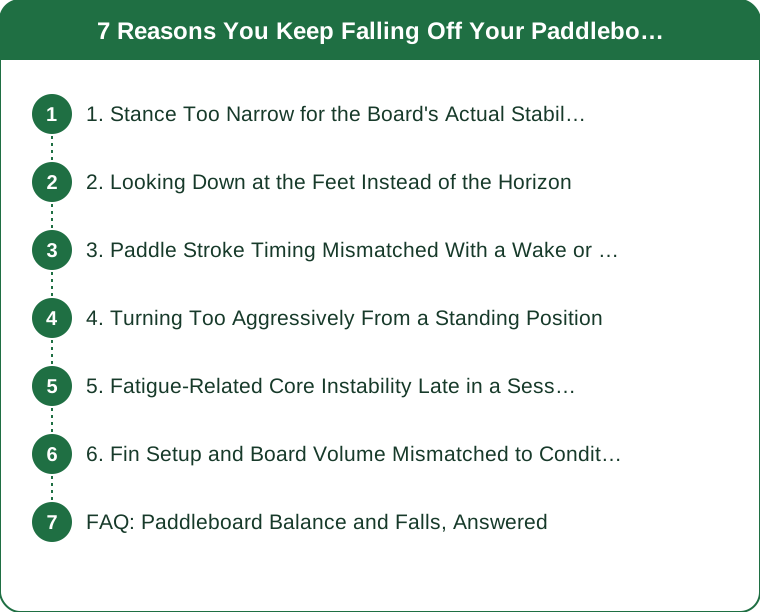
1. Stance Too Narrow for the Board’s Actual Stability Width
A stance narrower than shoulder width reduces the base of support significantly, and on a board with moderate rather than maximum stability, this narrow stance becomes the difference between staying balanced and tipping at the first small wobble. Widening the stance to just past shoulder width, with knees slightly bent, restores a meaningfully larger stability margin.
2. Looking Down at the Feet Instead of the Horizon
Looking down shifts body weight and head position forward and down, which destabilizes balance more than most paddlers realize, since balance relies heavily on a stable visual horizon reference. Consciously keeping the gaze on the horizon or a fixed distant point, rather than the board or water directly underfoot, meaningfully improves balance consistency.
3. Paddle Stroke Timing Mismatched With a Wake or Wave
Falling at a consistent moment during choppy water or when a boat wake passes often means the paddle stroke timing is out of sync with the wave’s actual rhythm, catching the paddler mid-stroke exactly when the board tips. Timing the paddle stroke to brace slightly during a wave’s peak, rather than mid-stroke through it, reduces this specific fall pattern.

4. Turning Too Aggressively From a Standing Position
A sharp, fast turn shifts weight suddenly, and if the turn is initiated from a fully upright rather than a slightly lowered, wider stance, that sudden weight shift is much more likely to overcome balance. Lowering the stance slightly and turning more gradually, especially during the learning phase, meaningfully reduces turn-related falls.
5. Fatigue-Related Core Instability Late in a Session
Falls that consistently happen later in a session, rather than early, often trace to core and stabilizer muscle fatigue rather than a technique flaw at all — a tired core simply can’t correct small wobbles as effectively as a fresh one. Recognizing this as a fatigue pattern, rather than a skill gap, points toward shorter sessions or planned rest breaks as the actual fix.
6. Fin Setup and Board Volume Mismatched to Conditions and Skill Level
A Fin That’s Too Small or Poorly Positioned Hurts Tracking Stability
A fin mismatched to current water conditions reduces tracking stability, which can produce a consistent wobble-and-fall pattern at a specific speed or turning moment, independent of paddler technique. Checking fin size and position against the board manufacturer’s recommendations resolves a surprising number of “technique” issues that are actually equipment issues.
Board Volume Too Low for Current Skill Level Lowers the Stability Ceiling
A board with volume and width below what current skill level comfortably supports has an inherently lower stability ceiling, meaning even correct technique still results in more frequent falls than the same technique would produce on a more stable board. Sizing up board volume, even temporarily while still building core paddling skills, removes this equipment-driven ceiling on stability.
FAQ: Paddleboard Balance and Falls, Answered
Does practicing on flat, calm water actually help with falls that happen in choppier conditions?
It helps build fundamental stance and stroke timing, but conditions-specific practice in mild chop is still necessary to build the reflexes for wave-timing falls specifically.
Is kneeling instead of standing a legitimate way to build confidence before falls stop happening?
Yes, kneeling significantly lowers the center of gravity and is a widely recommended intermediate step for building paddle stroke and steering skill before fully standing balance is solid.
How much does board width alone matter compared to length for stability?
Width generally matters more than length for basic stability, since a wider board provides a larger side-to-side base of support, which is the axis most falls happen along.
TL;DR:
- A repeated fall spot usually points to one specific, identifiable cause rather than random bad luck
- Stance width, gaze direction, and paddle-wave timing are the most common technique-driven causes
- Fatigue late in a session and equipment setup (fin, board volume) are common non-technique causes
- Matching the fall pattern to the specific cause is far more effective than generic balance advice
A paddleboard fall that keeps happening at the same spot is a genuinely useful diagnostic clue — working through these seven common causes usually reveals the actual fix faster than just practicing more in general.
Keep Reading
This article is for general informational and styling purposes only. Fit, sizing, and product availability may vary.