7 Signs Your Paddleboard Fin Setup Is Working Against You
Quick Answer: A paddleboard that constantly veers off a straight line, feels unstable in turns, or drags noticeably in shallow water is often a fin setup problem, not a paddling technique problem — mismatched fin size, wrong fin type for the water conditions, or a fin mounted in the wrong position on the track are the most common, fixable culprits.
Particular handling problems get blamed on technique for months when the actual cause is sitting right under the board the whole time. Here are seven signs the fin, not the paddler, is the issue.

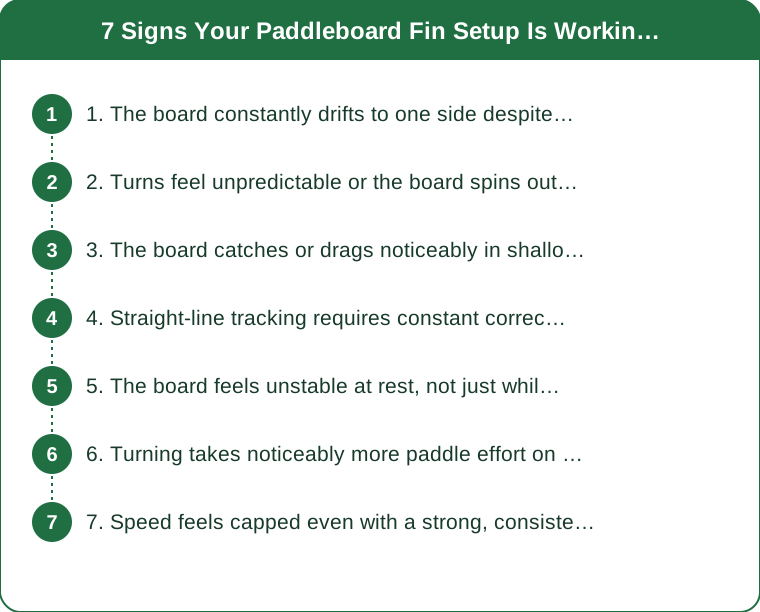
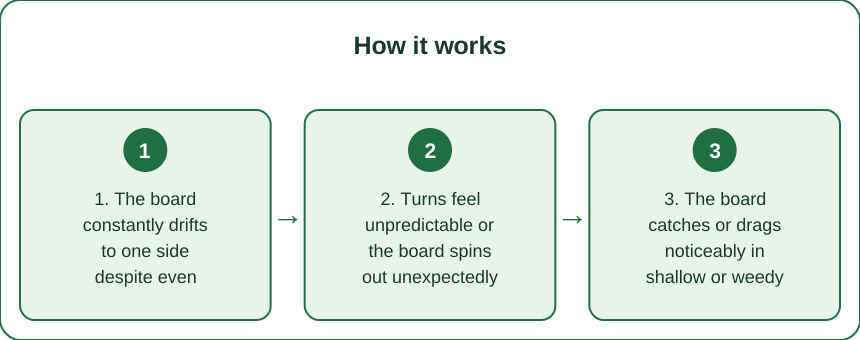
1. The board constantly drifts to one side despite even paddling
A consistent drift to one side, even with alternating and even-effort paddle strokes, often points to a fin that’s undersized for the board’s length and the paddler’s weight, since an undersized fin provides less directional resistance to counteract the board’s natural tendency to turn with each stroke.
2. Turns feel unpredictable or the board spins out unexpectedly
A fin mounted too far forward on the track, or a fin with too much flex for the conditions, can cause the board’s back end to lose grip and slide out mid-turn in a way that feels random but is actually a specific, correctable setup issue.
3. The board catches or drags noticeably in shallow or weedy water
A deep, performance-oriented fin designed for open water can catch on shallow bottoms or weeds in a way a shorter, more weedless-style fin wouldn’t, meaning the same fin that works well in one location can cause constant, frustrating drag in a different, shallower one.

4. Straight-line tracking requires constant correction strokes
If maintaining a straight line demands frequent correction strokes rather than occasional ones, the fin may be too small or positioned too far back, both of which reduce the board’s natural tendency to hold a straight track between paddle strokes.
5. The board feels unstable at rest, not just while paddling
Fin size and position affect a board’s stability profile even when not actively paddling, and a fin poorly matched to the board’s volume and the paddler’s weight can produce noticeable extra wobble at rest that’s frequently misattributed to core balance rather than equipment setup.
6. Turning takes noticeably more paddle effort on one side than the other
An asymmetric fin box position, or a bent or damaged fin that isn’t perfectly true, can make turns in one direction consistently harder than the other, a pattern that’s easy to mistake for a personal technique imbalance rather than a hardware issue.
7. Speed feels capped even with a strong, consistent paddling effort
An oversized fin for the board and conditions creates more drag than necessary, which can cap top speed regardless of paddling effort or fitness, meaning a speed plateau some paddlers attribute to fitness level is sometimes actually a fin sized larger than the situation calls for.
TL;DR:
- Constant drift, unpredictable turns, and shallow-water drag point to fin size or position, not paddling ability
- Fin type should match water conditions specifically — a deep performance fin isn’t right for shallow or weedy water
- Asymmetric turning difficulty often signals a bent fin or misaligned fin box, not a technique imbalance
- An oversized fin for the conditions caps speed through excess drag, independent of paddling effort
FAQ: Paddleboard Fin Troubleshooting, Answered
Is it worth owning more than one fin for different conditions?
Yes — many experienced paddlers keep at least two fin types (a deeper performance fin and a shorter, more weedless option) specifically to match different water conditions rather than compromising with one fin for everything.
How can a paddler tell if a fin is actually bent or damaged versus just the wrong type?
A visual check against a straight edge, or comparing handling side-to-side after confirming the fin box position is centered, can help distinguish a physically damaged fin from simply a mismatched but undamaged one.
Does fin position on the track matter as much as fin size?
Yes — sliding the same fin further forward or back on the track meaningfully changes turning responsiveness and tracking even without changing the fin itself, making position a worthwhile first adjustment to try before assuming a different fin is needed.
Keep Reading
This article is for general informational and styling purposes only. Fit, sizing, and product availability may vary.