Kayak or Paddleboard: Choosing Your Water Craft Personality
Quick Answer: Choose a kayak if your water plans involve cargo, distance, dogs, fishing gear, or anything other than flat calm — sitting means stability and mileage. Choose a paddleboard if you want a full-body balance workout, a better view into the water, and gear that stores in a closet. The tiebreaker nobody mentions is wind: a standing body is a sail, so windy home water favors kayaks decisively. Rent both five times before buying either.
The rental shed presents the choice every summer, and most people pick based on whichever one looks better in the photo they saw.
Kayak: seated, stable, cargo-friendly, faintly expeditionary. SUP: standing, core-demanding, minimalist, extremely photogenic.
Both are genuinely joyful. They’re different joys, and the difference matters a lot more once money is involved. Here’s the honest comparison — including the one factor that decides it for most people and gets mentioned almost nowhere.


When Should You Choose a Kayak?
When your water dreams involve things and distance.
Sitting buys you three advantages that compound the longer you’re out. Stability, because your center of gravity is roughly a foot lower than a paddleboarder’s — chop that would dump you off a board is a non-event in a kayak. Cargo, because you have hatches and a deck: picnics, a dog, camping gear, and a full fishing setup all travel comfortably. And distance, because a kayak is faster per unit of effort and you’re not spending energy on balance.
The workout is steady-state upper body and core. Genuinely demanding over 8 miles, but it’s endurance rather than the constant micro-engagement of standing.
The vibe is expedition. If the appeal is going somewhere — a distant shoreline, an island, a river with a takeout point — the kayak is your craft.
The costs: it’s bulky, it needs roof bars and a garage or shed, and getting it on and off a car alone is a real skill. Inflatable kayaks solve the storage problem and give up some speed and rigidity for it.
When Should You Choose a Paddleboard?
When your water dreams involve movement and minimalism.
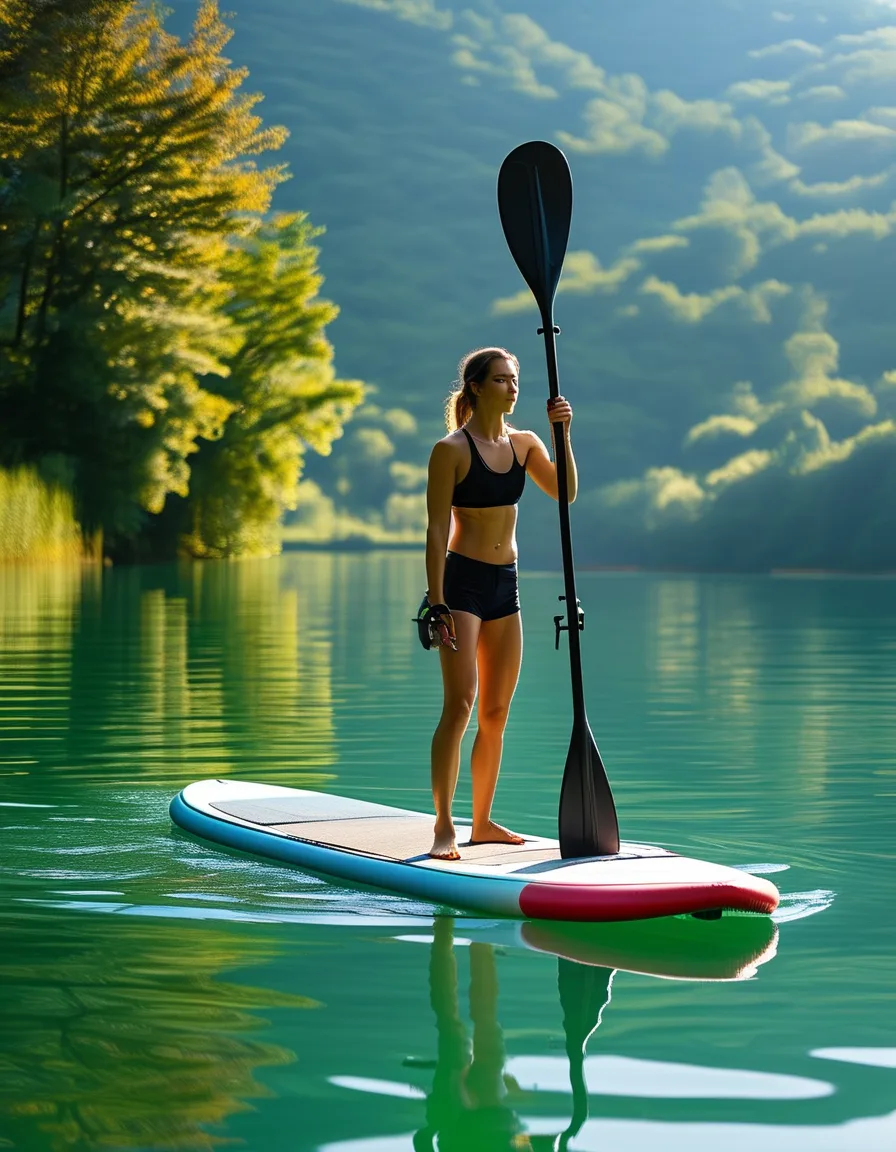
Standing means constant engagement — your legs, ankles, and core are working the entire time you’re out, which makes an hour on a SUP a legitimate full-body session in a way an hour of flat-water kayaking isn’t. It’s low-impact and surprisingly humbling for the first three sessions.
You also get a much better view into the water. Standing gives you a downward sightline through the surface — you see fish, weed beds, and rays that a seated paddler never notices. Underrated, and the thing SUP owners mention first.
And the board is a platform. Yoga, sitting down to fish, kids climbing aboard, jumping off for a swim and getting back on. A kayak is a vessel you’re inside; a board is a surface you’re on top of.
Transport is the biggest practical win. A quality inflatable SUP packs into a backpack and lives in a closet. No roof bars, no shed, no wrestling a 60 lb hull onto a car in a parking lot. For anyone in an apartment, this alone often settles it.
What About Wind? The Factor Nobody Mentions
This is the tiebreaker, and it’s the reason a lot of paddleboards end up in garages after one season.
A standing body is a sail. On a SUP you are a 5-to-6-foot vertical surface catching everything the wind has, on a board with almost no keel. In 12–15 mph of wind, paddling upwind on a SUP goes from exercise to a genuine problem, and getting blown offshore is one of the more common ways paddleboarders need rescuing.
A kayak sits low, has a hull below the waterline, and handles the same conditions as a mildly annoying day.
So audit your actual local water, not the vacation fantasy:
- Calm morning lakes and sheltered bays — SUP paradise.
- Afternoon chop, open water, coastal, anywhere with a reliable afternoon breeze — kayak territory.
- Rivers with current — kayak, generally, unless the river is very slow.
Check what the wind typically does at the place you’ll actually paddle, at the time you’ll actually go. The honest version of this audit changes a lot of people’s answer.

Should You Just Rent Instead of Buying?
For the first season, mostly yes — and this is the advice people regret ignoring.
Five outings on each before buying anything. Rentals run $25–60 a session, so ten sessions is $250–600 against a $700–1,500 purchase. If you end up buying, you’ll buy the right thing. If you don’t, you saved a grand and a storage problem.
Some genuinely useful plot twists:
- Hybrid setups exist. Several inflatable SUPs sell seat kits that convert them into a passable sit-on-top kayak. Not as good as either specialist craft, and a real answer if you’re truly torn.
- Sit-on-top kayaks split the difference the other way — easier to get back onto after a swim, more platform-like, less cargo capacity than a sit-inside.
- Most paddlers end up owning their personality and borrowing the other one on group days. That’s a perfectly good outcome.
Whichever you choose: wear the PFD, check the forecast including wind, and tell someone where you’re going. Cold water in particular deserves more caution than a warm air temperature suggests.
Myth vs Fact: Kayaks and Paddleboards
Myth: Paddleboards are the easier, more beginner-friendly option. Fact: A kayak is easier on day one — you’re seated and moving in five minutes. SUP takes two or three sessions before standing feels natural. The SUP’s real advantage is storage, not simplicity.
Myth: Inflatables are the compromise choice. Fact: Modern drop-stitch inflatable SUPs are close enough to hard boards that most recreational paddlers can’t tell. Inflatable kayaks give up more, but still plenty of craft for calm water.
Myth: You need a roof rack for either one. Fact: Only for a hard-shell. An inflatable SUP goes in a backpack and an inflatable kayak fits in a car boot, which is exactly why apartment dwellers end up on boards.
Myth: Calm water means safe conditions. Fact: Calm at 8am says nothing about 2pm. Afternoon thermal wind is a real pattern on most lakes and coasts, and it’s the reason to check the forecast for the hour you’ll be paddling back, not the hour you launch.
Mini FAQ
Is a kayak or paddleboard better for beginners?
A kayak is easier on day one — you’re seated, stable, and moving within five minutes. A SUP takes two or three sessions before standing feels natural, but the learning curve is short and the fall is into water. If you’re nervous about balance or the water is cold, start with the kayak.
Which one is a better workout?
A SUP, for full-body engagement per hour — your legs and core work continuously just to stay upright. A kayak wins for sustained upper-body and cardiovascular work over longer distances. Different workouts, both real.
Can you use a paddleboard in the ocean?
Yes, with caveats. Calm mornings and protected bays are excellent. Open coastal water with wind and swell is advanced territory, and offshore wind is genuinely hazardous on a board — always check the wind direction, not just the speed, and wear a leash.
TL;DR:
- Kayak for cargo, distance, dogs, fishing, and any water that isn’t reliably calm.
- SUP for full-body balance work, the view into the water, platform versatility, and closet-sized storage.
- Wind is the referee: a standing body is a sail, so breezy home water favors the kayak decisively.
- Rent both five times first — that’s $250–600 against a $700–1,500 mistake.
- Hybrid boards with seat kits exist for the genuinely undecided.
Cargo and distance: kayak. Balance and minimalism: SUP. Wind: the referee. Rent both first, then buy your personality — the lake accommodates either answer beautifully.
Keep Reading
This article is for general informational and styling purposes only. Fit, sizing, and product availability may vary.