Why You Keep Falling Off Your Paddleboard in the Exact Same Spot, Every Session
Quick Answer: Repeated falls at the same moment — usually during a turn, a paddle stroke transition, or a wake crossing — point to a specific weak point in stance or weight distribution that only gets exposed under that particular movement, not random bad luck. Isolating and drilling that exact movement on land or in calm water closes the gap faster than general balance practice.
If your falls keep happening at the same specific moment — turning around, switching paddle sides, crossing a wake — that’s not coincidence. It’s a specific mechanical gap getting exposed the same way every time.

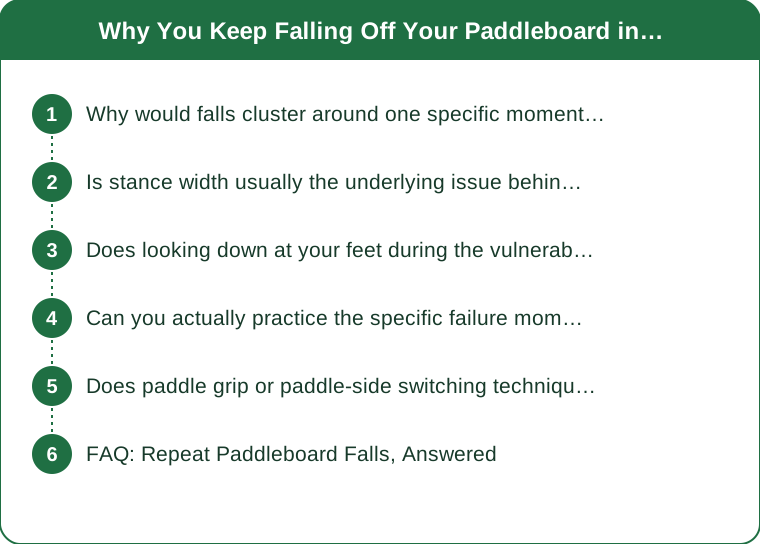
Why would falls cluster around one specific moment instead of being random?
Different moments on a paddleboard demand different balance adjustments — a turn shifts weight laterally, a paddle-side switch briefly changes upper body weight distribution, and crossing a wake requires absorbing vertical instability. A weakness in reacting to one of these specific demands will consistently show up at that moment and nowhere else, since the other moments don’t test the same weakness.
Is stance width usually the underlying issue behind these repeat falls?
Frequently, yes — a stance that’s too narrow provides less lateral stability margin, which is often fine during steady straight paddling but gets exposed specifically during a turn or sudden weight shift, where the narrow base doesn’t have enough margin to absorb the extra lateral movement. Widening stance specifically during the vulnerable moment (not necessarily the whole time) is a commonly cited fix.
Does looking down at your feet during the vulnerable moment make it worse?
Yes, measurably — looking down shifts head and upper body weight forward and down, which changes the board’s balance point at exactly the moment stability is already being tested. Keeping the gaze up and on the horizon during turns or transitions is a widely repeated coaching cue specifically because of this compounding effect.

Can you actually practice the specific failure moment without falling repeatedly in open water?
Yes — practicing the specific movement (a turn, a paddle switch) in very calm, shallow water, or even simulating the weight shift while standing on land or a balance board, isolates the exact moment without the added variables of wind, current, or wake. This targeted practice closes the specific gap faster than general paddling time, which mostly reinforces skills you’re already good at.
Does paddle grip or paddle-side switching technique specifically matter for this?
It can — an inefficient or rushed paddle-side switch briefly takes both hands off a stable double-hand grip, during which upper body stability depends entirely on stance and core. A smoother, more practiced switch technique reduces how long that vulnerable single-hand-transition window lasts.
FAQ: Repeat Paddleboard Falls, Answered
Does board width or volume affect how exposed a specific weakness becomes?
Yes — a narrower, lower-volume board reduces the margin for error at any weak moment, so beginners working through a specific repeat-fall pattern often benefit from a wider, more stable board while addressing the underlying technique.
Is core strength training actually relevant to fixing this specific pattern?
It helps generally, but targeted practice of the exact failure movement typically closes the gap faster than general core strength work alone, since the issue is often timing and weight-shift technique rather than raw strength.
Should you avoid the moment that causes falls until you’ve practiced it separately?
Not necessarily avoid it, but deliberately slowing down and exaggerating the correct technique during that specific moment in real paddling sessions reinforces the fix faster than avoiding it entirely.
TL;DR:
- Falls repeating at the same moment point to a specific balance gap, not general instability
- Turns, paddle-side switches, and wake crossings each test a different specific weakness
- Narrow stance and looking down both commonly compound instability during vulnerable moments
- Isolating and drilling the exact failure movement in calm water closes the gap faster than general practice
The same fall isn’t bad luck repeating — it’s the same gap getting tested the same way. Find the movement, drill it separately, and the pattern breaks.
Keep Reading
This article is for general informational and styling purposes only. Fit, sizing, and product availability may vary.